Custom Carcass Handling Equipment: SINOLIFT ML150 Case Study
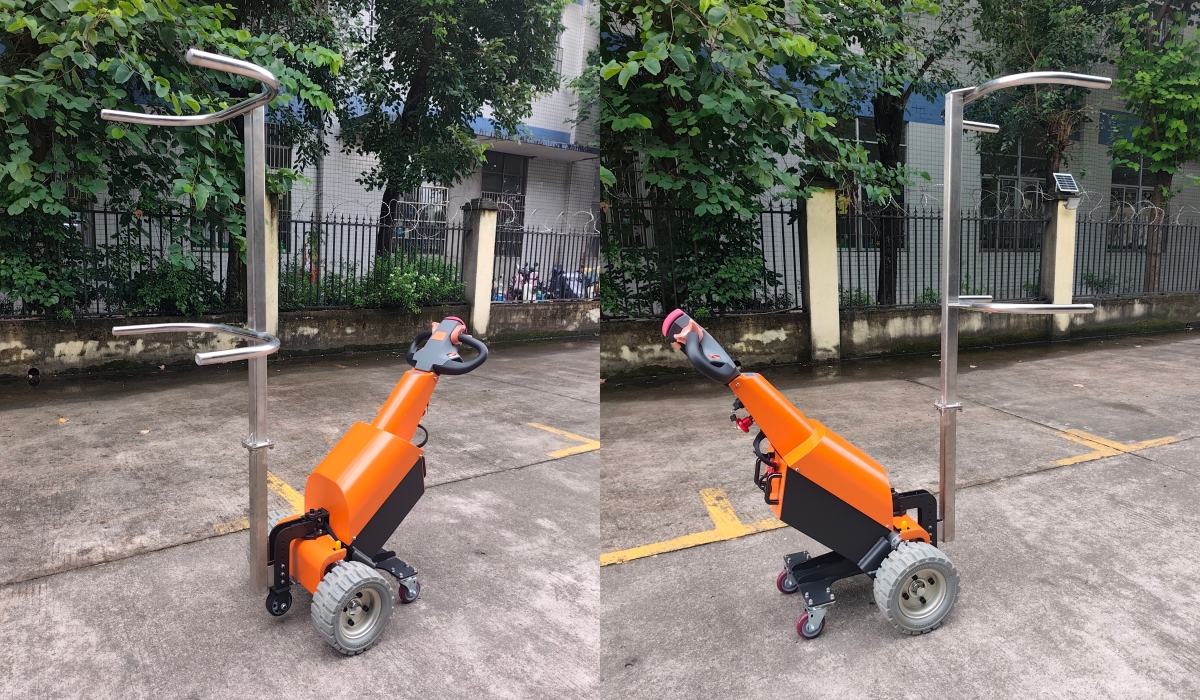
A customer-specific pedestrian tugger with a 304 stainless steel pushing attachment for moving heavy suspended meat loads along an existing overhead rail.
The challenge in a meat processing plant is not always lifting a heavy carcass. In many facilities, the carcass is already hanging safely from an overhead rail. The more difficult job is moving it to the right position for the next operation. When several suspended loads need to travel together, repeated manual pushing can demand considerable effort from the operator.
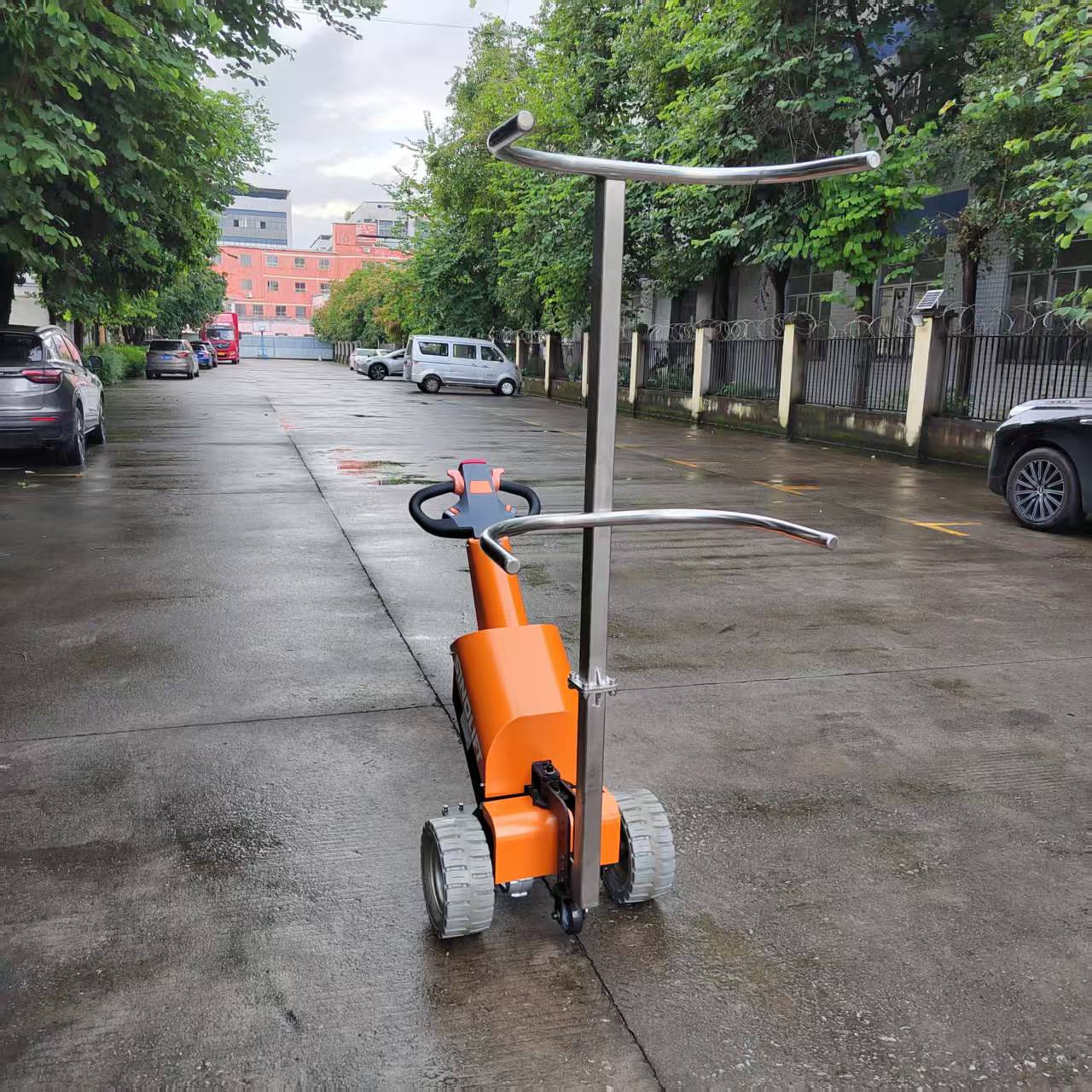
This was the application behind a SINOLIFT custom project based on the ML150 pedestrian electric tugger. The customer needed powered assistance for moving suspended meat carcasses, primarily pork, through a rail-based handling area. SINOLIFT developed a taller, purpose-built pushing structure made from 304 stainless steel and fitted it to the compact battery-powered ML150. The result is a specialized example of carcass handling equipment, rather than a conventional cart-towing machine.
PROJECT SNAPSHOT
Base machine: SINOLIFT ML150 pedestrian electric tugger
Project variant: ML-150-011
Purpose: Powered movement of suspended meat carcasses
Custom component: 304 stainless steel pushing attachment
Work setting: Overhead rail handling in meat processing
A movement problem the overhead rail could not solve by itself
An overhead rail supports the weight of a carcass and guides its travel path, but not every rail installation includes a fully powered conveyor. Some sections may still rely on an operator to move hanging loads forward. This can be practical for occasional transfers, yet becomes more demanding as carcass weight, rail resistance, or the number of hanging items increases.
The customer was not asking for a machine to lift meat off the floor. Nor was the requirement to replace the existing rail network. The useful function was much more specific: supply controlled horizontal pushing force while leaving the suspended load supported by the overhead system. That distinction shaped the choice of base vehicle and the design of the attachment.
The custom-built ML150 solution
SINOLIFT used the ML150 walk-behind electric tugger as the mobile power unit. In its standard form, the ML150 is intended to move wheeled loads using compatible hitches. For this project, the conventional low-level connection was replaced by an upright stainless steel pushing assembly that reaches the suspended-load working zone.
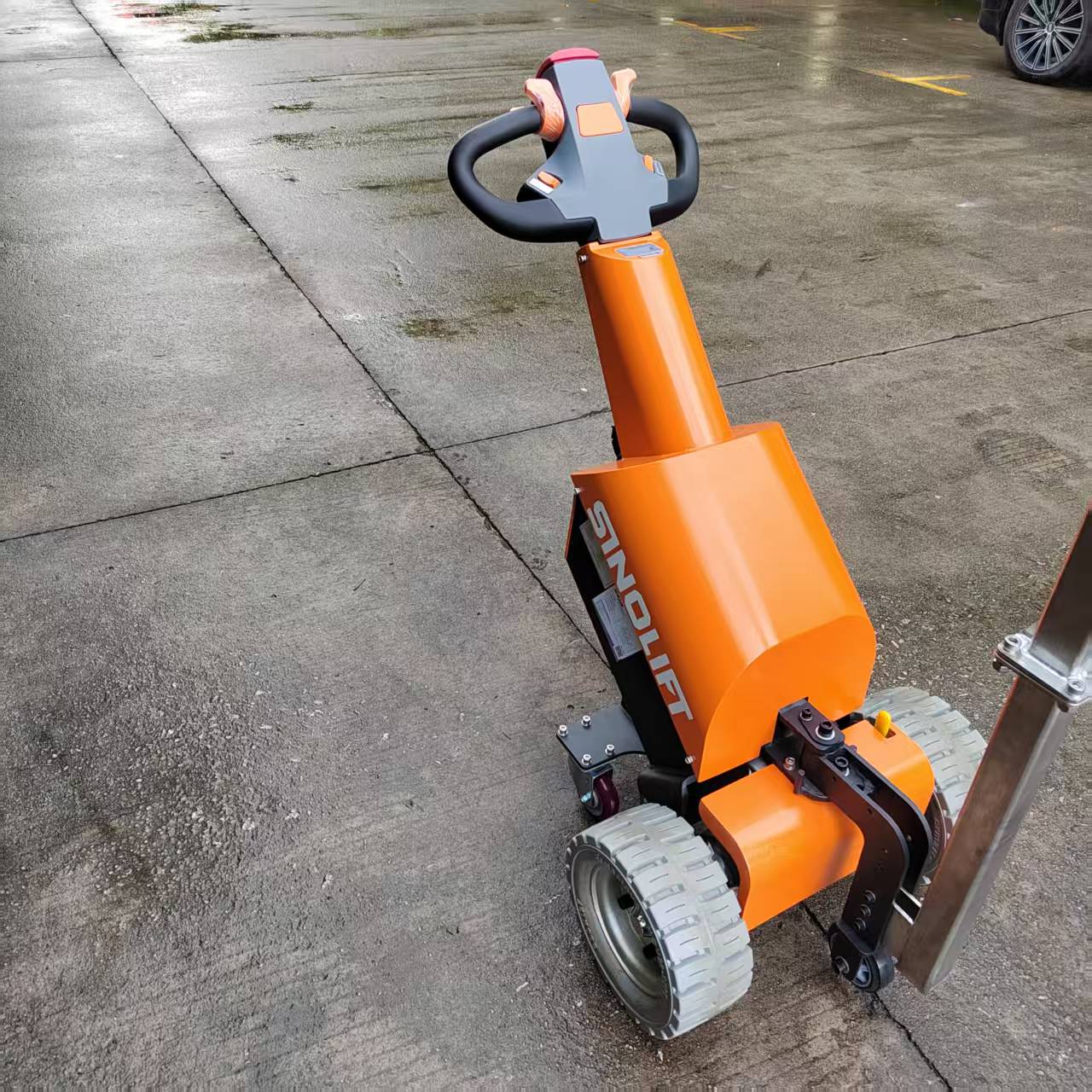
The supplied ML-150-011 engineering drawing identifies 304 stainless steel for the custom attachment and shows an approximately 1,800 mm-high structure. The finished-machine photograph shows the distinctive arrangement: an orange-and-black electric tugger, an upright stainless steel post, a curved upper arm, and projecting horizontal members. This is a practical way to bring motorized movement from floor level to a higher contact position without turning the tugger into a lifting machine.
The machine remains pedestrian-operated. The operator walks with the powered unit and uses its controls to position and move the attachment. The exact point of contact with the carcass or hanging hardware, and the approved operating procedure, must be determined for the customer's installation.
Why the stainless steel attachment matters
The feature that makes this order different is not simply the use of an electric motor. It is the shape and material of the interface between the machine and the suspended load. A standard tow hitch sits near floor level and is designed for wheeled equipment. An overhead meat rail presents an entirely different height, geometry, and contact arrangement.
A fabricated 304 stainless steel structure gives the design a durable, corrosion-resistant attachment material for a meat processing environment where moisture and cleaning may be important considerations. Its height and projecting sections can be engineered around the available clearance and the load position. The result is an application-specific pushing tool rather than a general-purpose warehouse accessory.
The use of 304 stainless steel should not be mistaken for automatic food-contact certification or approval for high-pressure washdown. Those requirements depend on the complete machine, surface finish, cleaning process, and the rules of the facility where it will operate.
What the powered tugger contributes
The standard ML150 platform offers battery-powered travel, a pedestrian steering handle, and forward and reverse speed control. The standard product information also lists an emergency-stop control, horn, and battery charge indicator. These familiar tugger functions make the machine an understandable starting point for a custom industrial application.
The standard ML150 specification lists a maximum traction weight of 1,500 kg and rated pulling force of 500 N. These are base-machine towing specifications, not a verified rating for pushing 1,500 kg of suspended carcasses. In a rail application, actual moving force depends on trolley wheels, rail condition, bends, inclines, starting resistance, attachment geometry, and the way loads are grouped. Any allowable pushing capacity must be established for the completed installation.
A use case for controlled transfers, not automatic processing
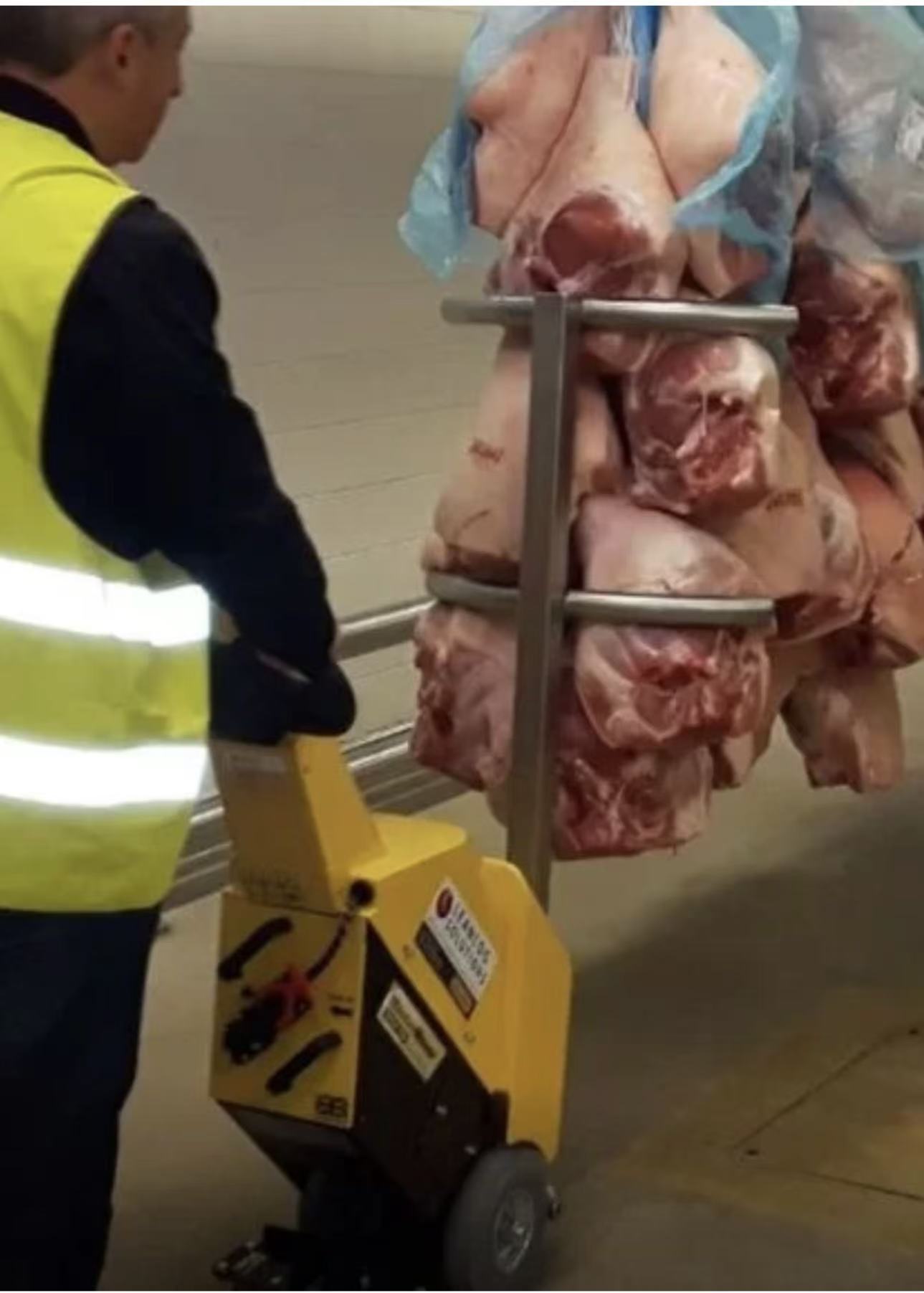
Consider the typical workflow in which hanging meat must be repositioned between a chilling area and the next production station. The rail holds the load above the floor, while workers need a way to advance it along the route. A mobile powered pusher can be relevant when movement is intermittent, local, or operator-directed.
For this SINOLIFT configuration, the intended concept is to bring the tugger into position, align the stainless steel attachment, advance the suspended load along the existing rail, and stop at the required location. It does not cut, lift, sort, or process the carcass. Its role is to support a specific transfer task. Whether it is suitable for a particular rail layout should be decided after reviewing the installation and operating conditions.
Pork today, other suspended meat loads when engineered for them
The customer project is centered on suspended pork carcasses, but the handling challenge is familiar across different meat sectors. Beef halves, venison, and other carcass types can also be carried on overhead systems. The same design principle - a floor-travelling powered unit with an elevated pushing interface - may be relevant to those operations.
That does not mean one attachment is automatically interchangeable across every species or rail. Carcass shape, hanging height, trolley spacing, total moving weight, and the required push location can differ substantially. A beef-processing facility or venison plant should therefore be treated as a new engineering application, even if it begins with the same ML150 tugger platform.
What buyers should share for a similar custom project
A useful quotation begins with the real transfer task, not only the weight of the heaviest carcass. SINOLIFT recommends sharing a few practical details before proposing a similar unit:
- Rail height and the location where pushing force should be applied.
- Carcass type, individual weight, and maximum number moved together.
- Rail layout, turns, slopes, trolley construction, and rolling condition.
- Floor space, doorway clearance, route length, and operating temperature.
- Cleaning practices and any food-contact or site-specific compliance requirements.
Buyers should clarify whether the planned contact is with the meat itself, a hook, a trolley, or a purpose-built rail fixture. This affects attachment geometry, surface requirements, and the forces transmitted through the equipment. They should also confirm the rail height, available floor clearance, turns and slopes, trolley condition, and how many carcasses must be moved at one time.
Cold-room temperature, condensation, cleaning methods, floor traction, and pedestrian access also matter. A trial using the real rail and representative loads is the most reliable way to confirm fit and operating limits. These checks help prevent a visually similar machine from being specified for an unsuitable installation.
What this order says about SINOLIFT customization
A standard tugger moves a trolley; this project required the same type of mobile electric drive to perform a very different task. The customer did not need a larger forklift or a generic towing hook. The requirement was a compatible machine-and-attachment combination that could reach the suspended working zone.
SINOLIFT responded by adapting an established ML150 platform and manufacturing a dedicated 304 stainless steel pushing structure. The custom engineering drawing and actual equipment photographs show how the design moved beyond a standard catalogue configuration. For a buyer, the value of this approach is the ability to discuss the real load, contact point, and operating environment before selecting an attachment.
SINOLIFT: custom solutions for non-standard material handling
Material handling problems rarely follow a single pattern. Some customers need to push hanging meat, while others must handle long rolls, awkward machine parts, unusual pallets, or loads that conventional forks cannot reach. In each case, successful customization starts with understanding the way the load is supported and the movement the operator needs to perform.
SINOLIFT supplies electric tuggers, pallet trucks, stackers, forklifts, and specialized material handling equipment, with customization options for non-standard applications. The ML150 carcass-handling project demonstrates how a familiar battery-powered machine can be adapted through a purpose-built attachment for a very specific industrial process.
If your facility needs equipment to move heavy suspended products or other unusual loads, send SINOLIFT a photo or drawing, the load details, and a description of the work area. Our team can review the requirement and discuss a suitable custom material handling solution.

Custom Electric Counterbalance Floor Crane for Confined Industrial Lifting