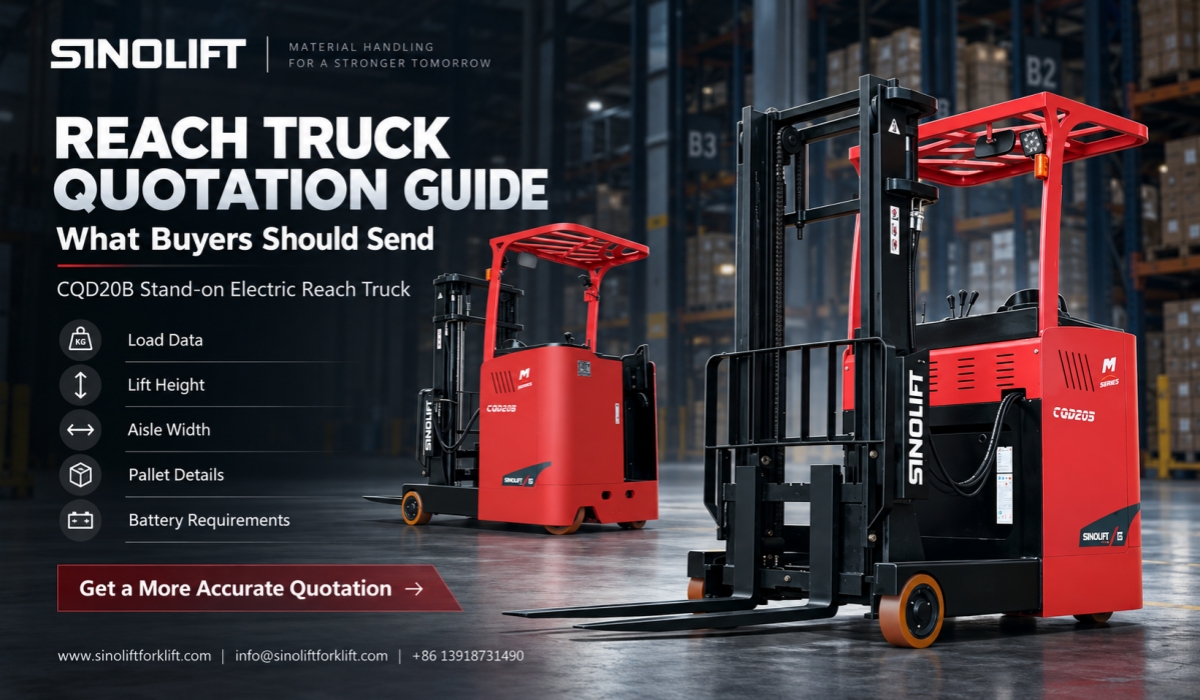
Electric Reach Truck Quotation Guide What Information Buyers Should Send
Quick Answer
For an accurate electric reach truck quotation, send more than the required tonnage. The supplier needs the maximum pallet weight, load dimensions, true load center, pallet construction, fork-entry direction, highest required fork position, clear aisle width, rack layout, floor condition, working hours, charging windows, and required attachments. Photos and a simple warehouse drawing prevent many misunderstandings. Ask the supplier to confirm residual capacity at height, right-angle stacking aisle, mast dimensions, battery and charger, fork size, options, warranty scope, and final technical drawing. All values should match the delivered configuration.
Key Takeaways
- Rated capacity alone cannot define the correct reach truck configuration.
- The heaviest pallet at the highest storage level is the key load case.
- Pallet entry direction and underside construction affect fork and support-leg compatibility.
- Battery selection should follow working hours, travel, lifting, and available charging time.
- A complete quotation should include configuration-specific dimensions and a capacity chart.
Why a Simple Tonnage Request Is Not Enough
A message that says only 'Please quote a two-ton reach truck' leaves the most important questions unanswered. Two pallets can weigh the same but need different trucks because one is deeper, stored higher, entered from a different side, or carried with an attachment. Two warehouses can also need different masts and batteries even when they handle the same pallet.
A useful electric reach truck quotation describes the complete job. It allows the supplier to check capacity at height, aisle fit, overhead clearance, pallet compatibility, energy demand, and safety options before quoting. The WorkSafe Victoria selection guidance similarly advises matching a forklift to the load, site conditions, operator abilities, and workplace hazards.
Start by reviewing the SINOLIFT electric reach truck range to understand the available stand-on, seated, double-deep, and walkie layouts. Then send the operating data before asking SINOLIFT to choose between individual models.
Describe the Load Before Choosing the Truck
The maximum load must include the pallet, packaging, product, and any container or fixture that travels with it. Do not use only the average pallet weight. The supplier needs the heaviest regular load and must know whether it will be stored at the top rack. If occasional loads are heavier, explain where and how they will be handled.
Load dimensions matter because capacity depends on the position of the center of gravity. A deep, long, liquid, or uneven load can place its center farther from the fork face than a compact pallet. OSHA's load-composition guidance notes that an oversized or incorrectly loaded item can move the actual load center outward and exceed the truck's capacity.
- Maximum weight, including pallet and packaging
- Overall length, width, and height after wrapping
- Whether the weight is evenly distributed or concentrated toward one side
- Whether the product can move, slosh, roll, or shift during handling
- The highest rack level assigned to the heaviest load
Show the Pallet and Fork Entry
A reach truck must physically enter and support the pallet. Send top, side, and underside photographs together with pallet dimensions. Mark the normal fork-entry direction. A 1,200 by 1,000 mm pallet produces a different load depth and turning envelope depending on which side faces the aisle.
Record the clear width and height of the fork openings, bottom boards, blocks, stringers, and any damaged or repaired areas. Closed-bottom pallets and unusual skids may conflict with a reach truck's support legs or fork geometry. When several pallet types are used, list all of them and identify which one creates the tightest opening or longest load center.
Measure Lift Height and Every Overhead Restriction
The required fork height is normally slightly above the beam that supports the highest pallet. The forks must rise enough to enter the pallet, lift it clear, and place or withdraw it without hitting the beam. Send the top beam height, pallet height, and available clearance above the load.
The route can limit the mast before the rack does. Measure doorways, roller doors, mezzanines, sprinkler pipes, roof members, conveyors, and low beams. OSHA lists overall lowered height, overall raised height, free fork height, and maximum fork height as critical forklift measurements. A triplex full-free-lift mast may help under low overhead structures, but the final mast and capacity still require confirmation.
Measure the Working Aisle and Rack Details
Measure the clear aisle at the narrowest operating point, not the nominal distance on an old rack drawing. Use the distance between the nearest rack faces, protectors, barriers, columns, or projecting pallets. Repeat the measurement at the entrance, middle, and far end. Include the end-of-aisle space where the truck must enter or leave.
Send a simple plan showing rack depth, lowest beam, pallet setback, flue space, rack protection, and any cross aisle. The supplier should compare this with the right-angle stacking aisle value for the proposed truck and actual pallet. Turning radius alone does not prove that a loaded truck can place a pallet at 90 degrees.
Explain the Floor Route and Working Environment
Reach trucks usually work best on smooth, hard, level indoor floors. Tell the supplier about cracks, expansion joints, ramps, slopes, dock plates, drainage channels, water, oil, dust, and outdoor crossings. Send photographs of the worst sections. Small industrial wheels and low ground clearance provide precise indoor handling but have limited tolerance for damaged surfaces and debris.
Temperature and contamination can change the required configuration. Cold stores may need suitable lubricants, protected electrical components, and a plan for condensation. Food, pharmaceutical, dusty, or corrosive environments may need special materials or protection. State the normal and minimum temperature and describe cleaning practices.
Define the Daily Work and Battery Plan
Working hours do not describe energy demand by themselves. One truck may travel long distances at low lift height, while another performs constant high lifts over a short route. Estimate pallets per hour, average travel distance, typical and maximum lift height, reach cycles, shift length, breaks, peak periods, and whether the truck can stop for charging.
Tell SINOLIFT whether the site prefers lead-acid or lithium power, whether battery exchange is possible, and what electrical supply is available for the charger. The battery, charger, connector, charging area, and working schedule must be planned as one system. Do not order a charger before the battery specification and local voltage are confirmed.
Match the Operator Layout to the Work
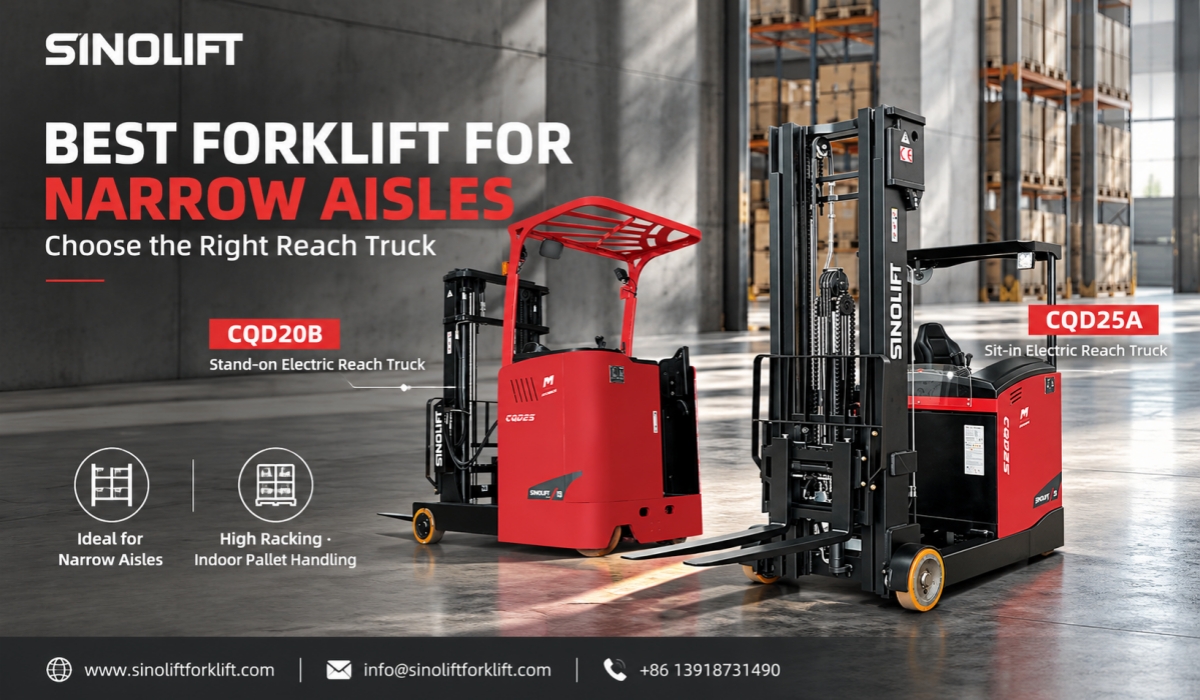
A stand-on layout can suit frequent short rack cycles and work that requires the operator to step off often. The CQD15B and CQD20B are published as stand-on models with 1,500 kg and 2,000 kg rated loads at a 500 mm load center. The MF20 and MF30 families provide other stand-on capacity choices within the SINOLIFT range. Final values depend on the selected mast and configuration.
A seated layout can suit longer travel and extended time on the truck. The CQD25A is published as a 2,500 kg seated moving-mast model with a 600 mm load center. Do not choose only from operator preference. Ask representative operators to test visibility, entry, controls, posture, and rack approach in a real or simulated cycle.
Ask for a Complete Supplier Response
A good quotation identifies exactly what is included. It should state the model, rated load, load center, mast type and lift height, closed and extended mast heights, free lift, fork size, battery, charger, steering and control type, tires or wheels, safety options, and attachments. It should also identify any items that require final confirmation.
Ask for the residual-capacity chart, dimensional drawing, right-angle stacking aisle for your pallet, and a list of supplied documents. ISO 3691-1 includes reach trucks with retractable masts or fork-arm carriages within its safety scope; the ISO overview is a useful reminder that the truck is a defined industrial machine, not a collection of interchangeable brochure numbers.
- Configuration-specific capacity chart and data plate information
- Dimensioned drawing showing mast, chassis, fork, and aisle dimensions
- Battery and charger specification for the local electrical supply
- Included options, spare parts, manuals, warranty, and delivery scope
- Training, commissioning, demonstration, and acceptance responsibilities
- Statement that final parameters are subject to the confirmed technical drawing and configuration
Use Photos and Video to Remove Uncertainty
Warehouse photographs help the supplier see details that a measurement list can miss. Take pictures along each critical aisle, at the aisle entrance, under the lowest overhead obstruction, and at floor defects. Include the pallet underside, the heaviest load, rack protectors, doors, slopes, and charging location. Mark dimensions directly on a simple plan when possible.
Ask SINOLIFT for product photos and a demonstration video of the proposed operator layout, mast, reach movement, controls, battery access, and relevant options. A video helps the purchasing team understand how the truck works, while the drawing and capacity chart confirm whether it fits the actual application.
Send a Complete Inquiry for a Useful Electric Reach Truck Quotation
The fastest route to a correct electric reach truck quotation is a clear application brief. Send load and pallet data, the highest storage requirement, aisle and rack measurements, route and floor photographs, working hours, charging conditions, temperature, operator layout preference, and required attachments. Separate confirmed requirements from preferences so that SINOLIFT can explain trade-offs.
Use the SINOLIFT contact page to submit the information and request a proposed model, technical drawing, residual-capacity chart, aisle confirmation, battery and charger details, product photos, and demonstration video. State that dimensions and performance must follow the final confirmed technical drawing and configuration before ordering.
7 FAQ
What information is needed for an electric reach truck quotation
Provide the maximum load weight and dimensions, pallet construction and entry direction, lift height, aisle width, rack layout, floor and route conditions, working hours, temperature, charging time, and attachments. Photos and drawings are strongly recommended.
Why does the supplier need my pallet dimensions
Pallet depth affects load center and aisle space, while fork openings and underside construction determine whether the forks and support legs can enter safely. The same weight on a deeper pallet may require a different capacity check.
Should I request rated capacity or capacity at height
Request both, but use residual capacity at your required height, load center, and reach position for the buying decision. The nominal floor-level rating does not guarantee the same load at the top rack.
How should I measure the reach truck aisle
Measure the narrowest clear distance between rack faces, protectors, barriers, or projecting pallets at several locations. State the pallet size and fork-entry direction and ask for the matching right-angle stacking aisle value.
Can I choose the battery after ordering the truck
Battery type and size affect weight, compartment dimensions, charging, operating time, and sometimes truck configuration. Confirm the battery and charger with the truck before the purchase order is finalized.
What documents should be included with the quotation
Ask for a technical specification, dimensional drawing, residual-capacity chart, battery and charger details, option list, manuals, warranty scope, delivery scope, and confirmation of the final data plate.
Can SINOLIFT recommend a model from warehouse photos
Photos are helpful but should be supported by measurements. SINOLIFT still needs the load, pallet, lift height, aisle, rack, floor, duty cycle, and charging data to recommend and confirm a configuration.
Best Forklift for Narrow Aisles When a Reach Truck Is the Right Choice