How Does an Electric Self Lifting Stacker Work for Trucks and Vans

Quick Answer
An electric self-lifting stacker is a compact powered machine that lifts and moves palletized goods and can also raise its own chassis into a compatible truck or van. The machine travels with the delivery vehicle, so the driver does not have to rely on a loading dock or a forklift waiting at every destination. It is especially useful for store deliveries, equipment distribution and other routes that serve locations with limited unloading facilities. The key word is compatible: the load, pallet, truck-bed height, cargo opening, vehicle payload and unloading surface must all match the selected stacker. For the SINOLIFT CDDYG-Z family, published options include 500 kg or 1,000 kg capacity and maximum fork heights of 1,100 mm, 1,300 mm or 1,500 mm.
Key Takeaways
- The stacker can travel with the delivery vehicle and unload pallets where no destination forklift is available.
- Powered driving and powered lifting reduce the pushing and manual pumping required during repeated deliveries.
- The CDDYG-Z range offers 500 kg and 1,000 kg rated capacities at a 400 mm load center.
- The equipment is not suitable for every truck, pallet or surface, so vehicle and application measurements are required before purchase.
- A trained operator may complete the work alone when the machine, load, vehicle and site have all been approved for the task.
The Delivery Problem This Machine Solves
The main problem is simple: a truck arrives with a pallet, but the customer has no forklift and no loading dock. The driver may have to wait for outside equipment, arrange extra workers or return with the goods. A normal pallet truck can move a pallet once it is on the ground, but it cannot lower the pallet from the truck bed by itself. A normal warehouse stacker can lift pallets, but it usually cannot load its own chassis into the delivery vehicle.
An electric self-lifting stacker combines these jobs in one machine. It moves the pallet, raises or lowers the load and uses a support mechanism to transfer the stacker between ground level and the cargo floor. After unloading, the machine can be loaded back into the truck and secured for the next stop.
Imagine a distributor delivering a pallet of components to a small workshop. The workshop door is wide enough for the pallet, but the site has no forklift. The driver parks on a firm, level area, unloads the stacker from the truck, collects the pallet and moves it into the receiving area. The unloading solution arrives with the goods instead of depending on the customer. That independence is the main value of an electric self-lifting stacker.
How the Self Lifting Process Works
The self-lifting process uses controlled movement between the forks, mast, chassis and support legs. The exact sequence depends on the model, so the operator must follow the manufacturer's manual and training. A typical process looks like this.
- The driver parks the vehicle on a firm and level surface, applies the parking brake and keeps pedestrians away from the work area.
- The operator checks the stacker, the cargo opening, the truck-bed height and the support contact area before beginning the transfer.
- The support legs are extended and positioned according to the operating instructions.
- The electric hydraulic system raises or lowers the stacker chassis until it aligns with the cargo floor.
- The stacker moves into or out of the vehicle at low speed, after which the operator retracts the support system in the correct order.
- Inside the vehicle, the stacker is parked and secured at approved restraint points before road travel.
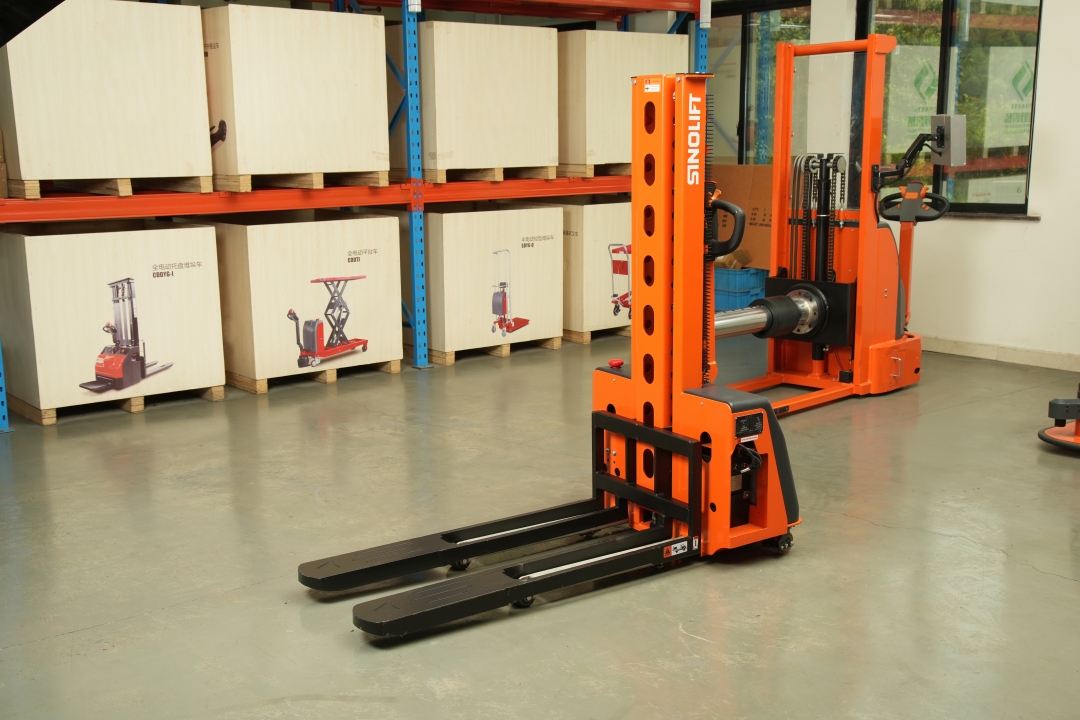
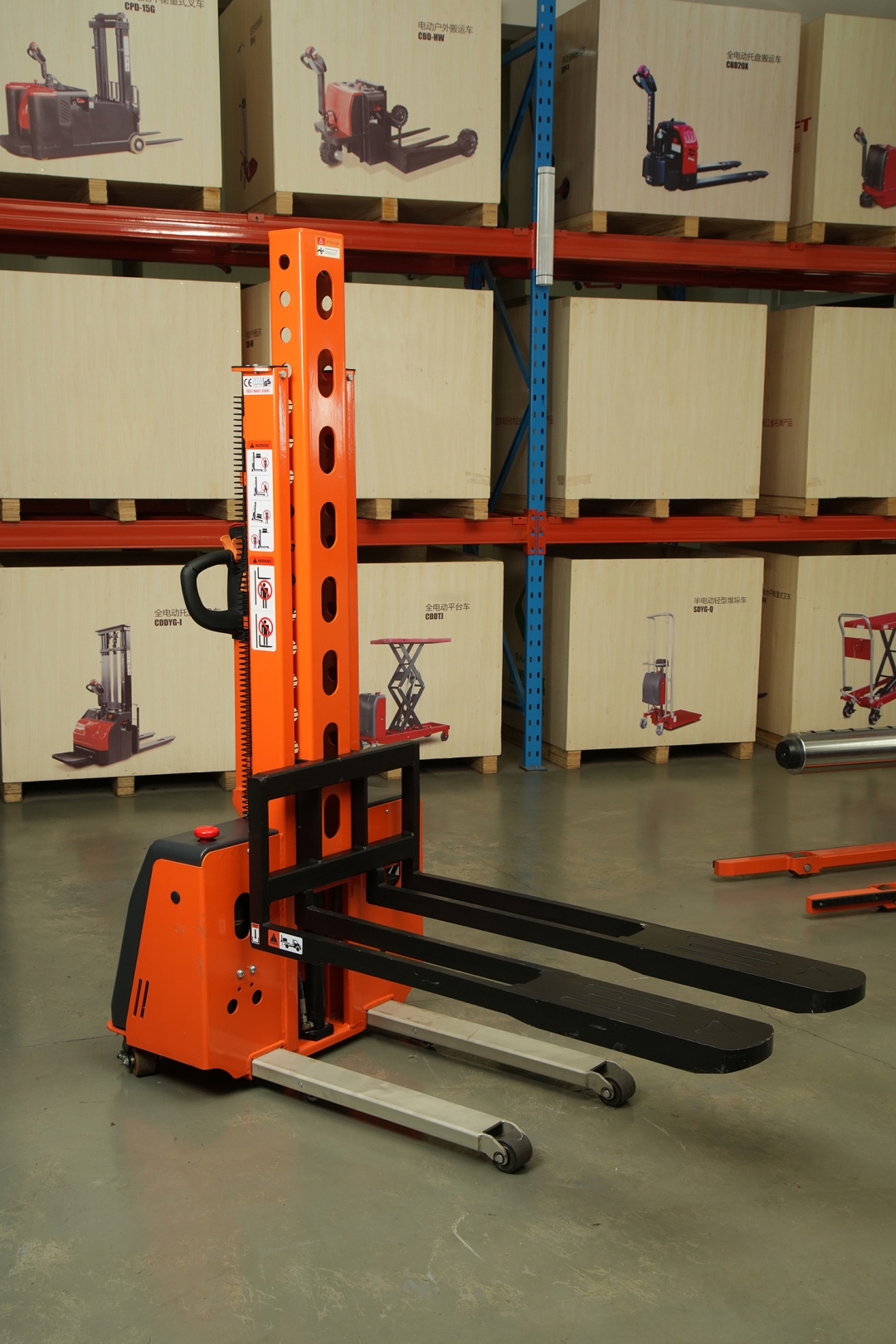
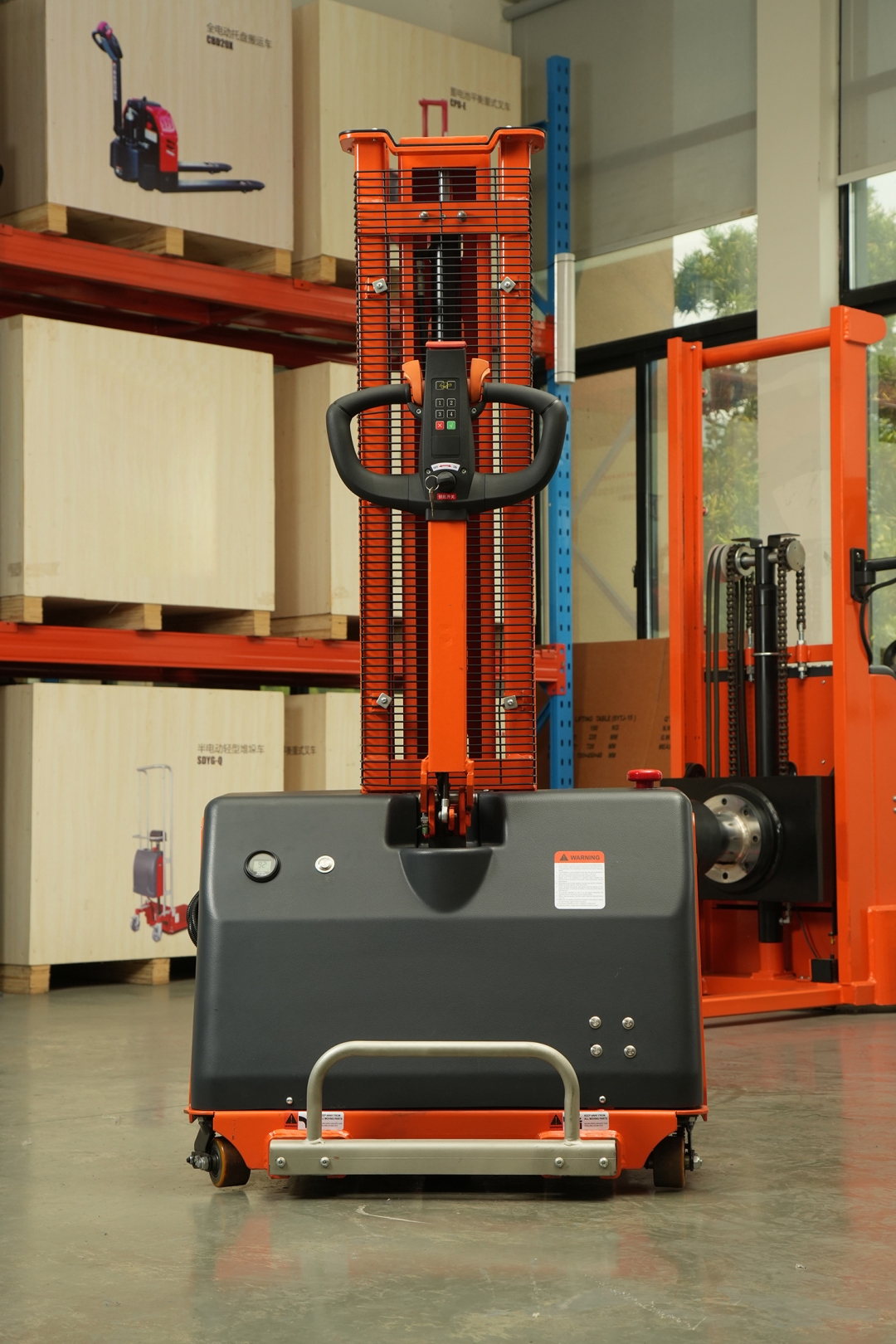
The CDDYG-Z electric self-lifting stacker uses powered travel and electric-hydraulic lifting. Its sliding support-leg system is designed to let the machine transfer itself onto a compatible truck or van without a second forklift. This does not mean the machine fits every vehicle. The buyer must still confirm dimensions, floor strength, payload and safe support contact points.
Can One Person Complete the Unloading
One trained operator may complete the unloading cycle when the complete application has been approved. The machine provides powered travel and lifting, so the operator does not have to manually pump the forks or push a heavy loaded truck over the full route. This can make repeated deliveries more practical for a single driver.
However, one-person operation is not a promise that applies everywhere. A second person may still be needed to control traffic, open gates, guide the operator where visibility is restricted or manage an unusual load. Local rules may also require specific operator training or site controls. The correct question is not only whether one person can operate the machine, but whether one trained person can complete the exact route safely and repeatedly.
Five Questions to Answer Before Choosing a Model
How Heavy Is the Complete Pallet
Start with the heaviest complete load, including the pallet, packaging, product and any fixture. The CDDYG-Z family is published with 500 kg and 1,000 kg capacity options. A pallet weighing more than 500 kg requires the higher-capacity model or another approved solution. Do not select capacity from the average pallet because the heaviest expected load controls the decision.
The published rating uses a 400 mm load center. In plain language, this means the weight must be positioned close enough to the mast for the machine to remain within its rating. A long pallet, an overhanging item or a load that is heavier on the far side can move the center of gravity forward and reduce the usable capacity. Send the supplier the load length and a photograph or drawing when the load is not a normal evenly distributed pallet.
How High Must the Forks Reach
Measure the actual truck cargo-floor height and any other height where the pallet must be placed. Available CDDYG-Z maximum fork heights are listed as 1,100 mm, 1,300 mm and 1,500 mm. Choose a configuration that covers the required height without buying an unnecessarily tall mast. A taller mast can increase the closed height and machine weight, so it must still clear the vehicle opening and cargo space.
Will the Stacker Fit Inside the Vehicle
Published CDDYG-Z dimensions include an overall length of 1,730 mm and an overall width of 800 mm. The minimum turning radius is listed as 1,160 mm. Overall height depends on the selected lift configuration and ranges from 1,480 mm to 1,880 mm. Measure the smallest clear opening, including door seals, hinges, handles, steps and any bodywork that reduces usable space.
The vehicle must also have enough legal payload. Published net machine weight ranges from approximately 340 kg to 390 kg, depending on configuration. Add the driver, cargo, pallet, battery and restraints when checking gross vehicle and axle limits. A machine can physically fit inside a van and still be unsuitable if it uses too much payload or places too much load on the cargo floor.
What Pallets and Floors Will Be Used
The published fork length is 1,220 mm, fork outside width is 581 mm and minimum fork height is 60 mm. Compare these dimensions with the pallet openings and bottom-board design. Damaged pallets, closed-bottom pallets, loads with excessive overhang and unusual skids require separate confirmation. The wider self-loading pallet stacker range may contain a more suitable layout when the standard forks do not match the load.
Compact stacker wheels work best on firm, smooth and level surfaces. Loose gravel, potholes, wet slopes, high curbs and soft ground can reduce stability or prevent movement. If most unloading takes place on rough construction sites, choose equipment designed for that surface rather than expecting a compact delivery stacker to perform like a rough-terrain forklift.
How Many Deliveries Are Made Each Day
The listed CDDYG-Z battery is 24 V 40 Ah, with a 0.75 kW drive motor and a 0.8 kW lift motor. These specifications describe the electrical system, but they do not guarantee a fixed number of hours for every user. Runtime changes with load weight, travel distance, lift frequency, floor resistance and temperature. Give the supplier the number of stops, approximate travel distance at each stop and charging time available between routes.
How Is It Different from Other Equipment
Compared with a Normal Pallet Stacker
A conventional stacker lifts and stacks pallets inside a warehouse, but it normally remains in the building. An electric self-lifting stacker is designed to travel with a truck or van and transfer its own chassis between the ground and cargo floor. Buyers who mainly need indoor racking and higher stacking should compare the broader pallet stacker range instead.
Compared with an Electric Pallet Truck
An electric pallet truck is excellent for moving pallets horizontally at floor level. It has only a small lift that clears the pallet from the ground. It cannot normally lower itself from a truck bed. Review electric pallet trucks when the loading dock or lift platform already solves the vertical transfer.
Compared with a Hand Pallet Truck
A hand pallet truck is simple and economical for occasional moves on level floors, but the operator supplies the travel force and hydraulic pumping. It also needs a separate way to reach the truck bed. Hand pallet trucks remain a practical choice when loads are light, travel is short and unloading infrastructure is always available.
Compared with a Truck Tail Lift
A tail lift is permanently installed on the delivery vehicle. It moves a pallet truck or load between the truck bed and the ground, but the driver still needs equipment to move the pallet after the platform is lowered. An electric self-lifting stacker is carried as a separate machine and usually does not require a permanent hydraulic platform installation. The best choice depends on vehicle design, payload, types of cargo and how far the pallet must move after unloading.
Compared with a Destination Forklift
A receiving forklift is efficient when every destination has suitable equipment and a trained operator ready. The weakness is dependence: the driver may wait, reschedule or be unable to unload at an unstaffed site. A self-lifting stacker gives the delivery team more control, but it also uses vehicle payload and must be maintained, charged and secured in transit.
Where This Stacker Is a Good Fit
- Retail stores and small warehouses without loading docks
- HVAC appliances machinery parts and other palletized equipment deliveries
- Beverage foodservice and component routes with several delivery stops
- Factories moving suitable pallets between buildings
- Service and rental fleets that cannot depend on destination forklifts
- Routes where powered travel is useful after the pallet reaches the ground
The strongest application has repeatable pallets, compatible vehicles and prepared unloading areas. Buyers should test the machine with the actual van or truck and the heaviest normal pallet. A short demonstration with an empty machine is not enough to confirm the complete job.
When This Stacker Is Not the Right Choice
- Loads exceed the approved capacity or have an unknown center of gravity
- The vehicle opening cargo floor payload or restraint points are unsuitable
- The route requires travel over gravel potholes steep slopes or soft ground
- Pallets do not provide compatible fork openings
- Most work involves high warehouse racking rather than vehicle unloading
- The destination already provides reliable high-throughput unloading equipment
Selecting another machine in these conditions is not a failure of the product. It is good application engineering. The purpose of the buying process is to match the equipment to the real work instead of forcing one model into every situation.
Simple Safety Checks for Daily Use
The operator should inspect the machine before each shift. Check the forks, mast, chains, support legs, wheels, hydraulic system, controls, brakes, emergency stop and battery. Any defect that affects lifting, steering, braking or the self-loading mechanism should remove the machine from service until it is repaired.
The transfer area should be level, firm, well lit and clear of pedestrians. The load should remain stable and centered, and the forks should be kept low during travel. Inside the vehicle, the stacker must be secured using an approved method before the vehicle moves.
In the United States, OSHA powered industrial truck rules require employers to ensure that operators are trained and evaluated for the truck and workplace conditions. Other markets have their own requirements. ISO 3691-5 provides a safety framework for specified pedestrian-propelled trucks within its scope. Ask the supplier which standards and documents apply to the exact model and destination country.
Information to Send When Requesting a Quotation
A useful inquiry gives the supplier enough information to check the application. Send clear photographs and the following measurements.
- Maximum complete pallet weight and normal weight range
- Pallet length width height and fork-entry direction
- Required truck-bed or placement height
- Vehicle cargo-opening width and height
- Cargo-floor dimensions floor rating and legal payload
- Distance the loaded stacker must travel at each stop
- Floor condition gradients thresholds and outdoor exposure
- Number of deliveries and lift cycles per day
- Country of use required documents and available electrical supply
Ask the supplier to confirm the selected capacity, load center, mast, battery, overall dimensions, machine weight and vehicle compatibility in writing. If possible, complete a witnessed test with the real vehicle and a representative load before final acceptance.
Conclusion
An electric self-lifting stacker is designed for a clear problem: delivering palletized goods to places that may not have a forklift or loading dock. Its value is easy to understand when the complete job is considered. The machine travels with the vehicle, moves between the cargo floor and ground and then carries the pallet to the receiving point.
For suitable loads, vehicles and surfaces, the CDDYG-Z can give a delivery team more control and reduce dependence on customer equipment. The decision should still be based on measurements. Confirm the pallet, load center, lift height, vehicle opening, payload, floor strength, surface and daily duty before ordering. A correctly matched stacker can make difficult deliveries more predictable; an incorrectly matched stacker will create new problems.
Frequently Asked Questions
Can an electric self lifting stacker load itself into any truck or van
No. The vehicle must have compatible bed height, cargo-opening clearance, floor strength, payload, usable space and support contact points. Send the vehicle dimensions and photographs to the supplier before selecting a model.
Can one driver unload a pallet without a forklift
A trained driver may complete the work alone when the machine, vehicle, pallet and unloading area are approved. Some sites may still need a spotter or traffic controller because of visibility, pedestrians or local rules.
What is the maximum load of the CDDYG-Z
Published CDDYG-Z options are rated for 500 kg or 1,000 kg at a 400 mm load center. The complete pallet weight, weight distribution and required lift height must match the selected configuration.
What lifting heights are available
The published maximum fork-height options are 1,100 mm, 1,300 mm and 1,500 mm. Measure the real truck-bed and placement heights before choosing the mast.
Does the truck or van need to be modified
A permanent tail-lift installation is not normally the operating idea, but compatibility still requires review. The cargo floor, opening, payload, support contact area and restraint points must be suitable for the machine.
Can the stacker work on outdoor ground
It can work only on surfaces allowed by the manufacturer. Compact wheels are generally best on firm, smooth and level ground. Gravel, potholes, soft ground and steep slopes may require rough-terrain equipment.
How long does the lithium battery work
There is no single runtime for every route. Load weight, travel distance, lift cycles, floor condition and temperature all affect energy use. Give the supplier your daily work pattern and confirm the required battery reserve and charging plan.
Authoritative Sources
- OSHA 29 CFR 1910.178 Powered Industrial Trucks
- OSHA Load Composition Guidance
- ISO 3691-5 Pedestrian Propelled Trucks
- UNECE Manual of Tests and Criteria Rev 8 and 2025 Amendment

How to Choose Paper Roll Handling Equipment For Printing Packaging and Converting Plants