Best Forklift for Narrow Aisles When a Reach Truck Is the Right Choice
Narrow-Aisle Selection Guide
Best Forklift for Narrow Aisles: When a Reach Truck Is the Right Choice
Choose around the real pallet, real rack height and real travel route—not a brochure width alone. This guide explains when an electric reach truck is the better warehouse tool and when a counterbalance forklift still wins.
Quick answer
When is a reach truck the best forklift for narrow aisles?
The best forklift for narrow aisles is usually an electric reach truck when the work involves full pallets, high racking, smooth indoor floors and repeated right-angle stacking. A counterbalance forklift is usually more suitable for trailers, loading docks, yards, rough surfaces and loads that cannot fit between a reach truck's support legs.
Do not choose from rated capacity or overall width alone. Measure the actual pallet, clear rack-to-rack aisle, highest fork position, door height, floor condition and full travel route. The final model must also retain enough capacity at the required lift height.
Key takeaways
Five checks that prevent the wrong truck choice
- Reach trucks are designed for indoor pallet storage in narrow aisles and high racking.
- Counterbalance forklifts remain better for docks, trailers, yards and mixed indoor/outdoor routes.
- The right-angle stacking aisle value is more useful than turning radius when checking rack access.
- Pallet openings, load overhang, floor condition and capacity at height can change the final choice.
- A demonstration with the real pallet and rack is the best way to confirm fit before ordering.
Truck choice
Why narrow-aisle buyers often compare the wrong numbers
A narrow warehouse does not automatically need the smallest truck. The selected machine must complete the entire loaded stacking cycle with enough clearance for repeatable operation.
The truck must turn with the loaded pallet, place it squarely on the beams, withdraw the forks and leave enough room for the operator to correct alignment. Rack protectors, columns, pallet overhang, stretch film and damaged floors all reduce usable space. A brochure width or turning radius does not describe that complete movement.
OSHA identifies reach trucks as Class II electric narrow-aisle trucks used for high-tier storage. Its narrow-aisle guidance also warns about overload and tip-over risk during high lifting. The goal is not the smallest possible aisle; it is an aisle where the selected truck can repeat the full cycle with the real load and appropriate operating clearance.
Choose a reach truck when…
- Most work is inside controlled rack aisles.
- High-level pallet storage is the primary job.
- Floors are smooth, level and dry.
- Pallet sizes and entry directions are controlled.
- Compact right-angle stacking is essential.
Choose a counterbalance forklift when…
- The route includes docks, trailers or yards.
- Surfaces are wet, uneven or partly outdoors.
- Loads use unusual skids or closed-bottom pallets.
- Direct floor and vehicle access matters most.
- One truck must cover mixed general-handling tasks.
| Selection factor | Electric reach truck | Counterbalance forklift |
|---|---|---|
| Best environment | Smooth indoor warehouse floors | Docks, trailers, yards and mixed routes |
| Primary task | High-rack put-away and retrieval | General loading, transport and floor pickup |
| Aisle need | Optimized for narrower rack aisles | Usually needs more turning space |
| Pallet compatibility | Must clear support legs and fork arrangement | More direct access to varied pallets and skids |
| Outdoor use | Only if the exact model and route are approved | More suitable configurations are available |
Operating principle
How an electric reach truck works
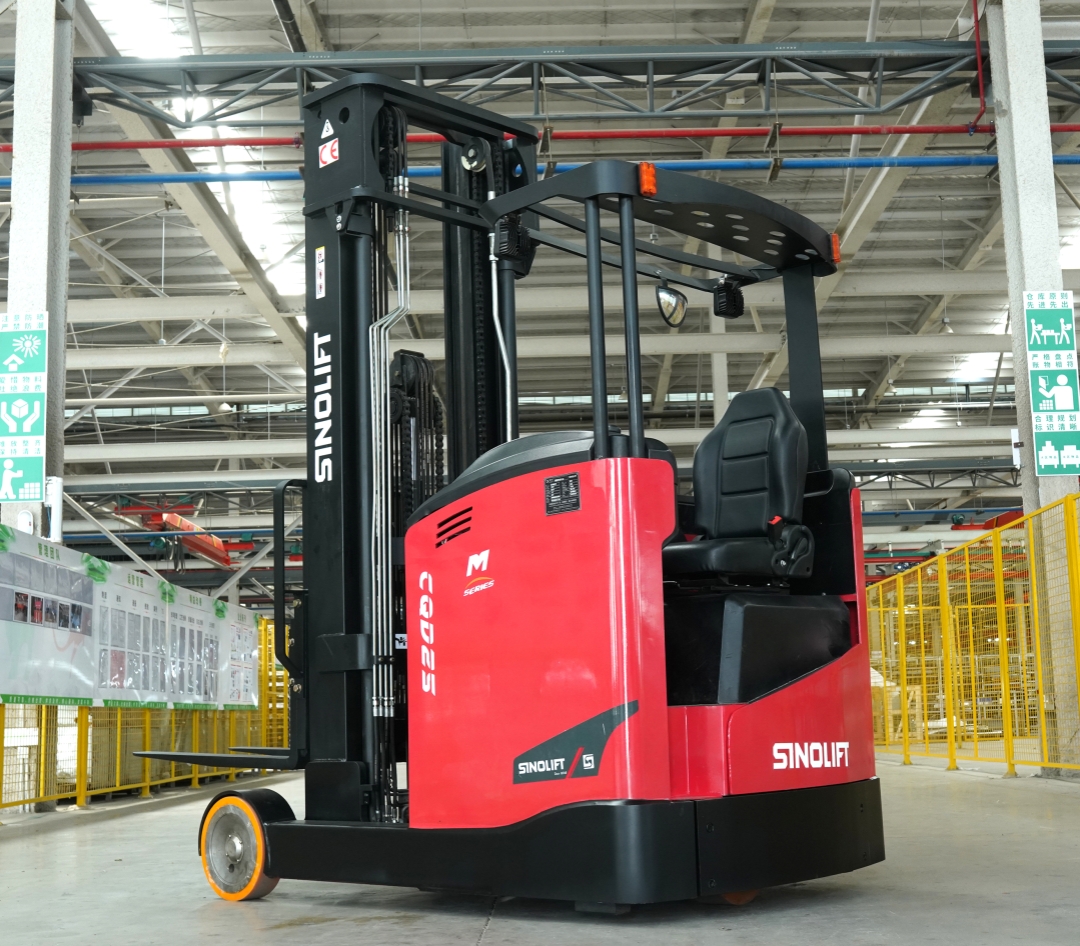
A reach truck keeps most of its chassis inside the aisle while the mast or fork carriage moves toward the rack. Front support legs help stabilize the truck. After the forks enter the pallet and lift it clear, the reach mechanism retracts the pallet closer to the truck for travel. This layout reduces the space needed for right-angle stacking compared with many conventional counterbalance forklifts.
This design also creates limits. Pallet openings must clear the forks and support-leg arrangement. Small industrial wheels and low ground clearance perform best on smooth, level and dry floors. Moving the mast or forks forward changes the load position, so capacity must be checked at the required lift height and reach position.
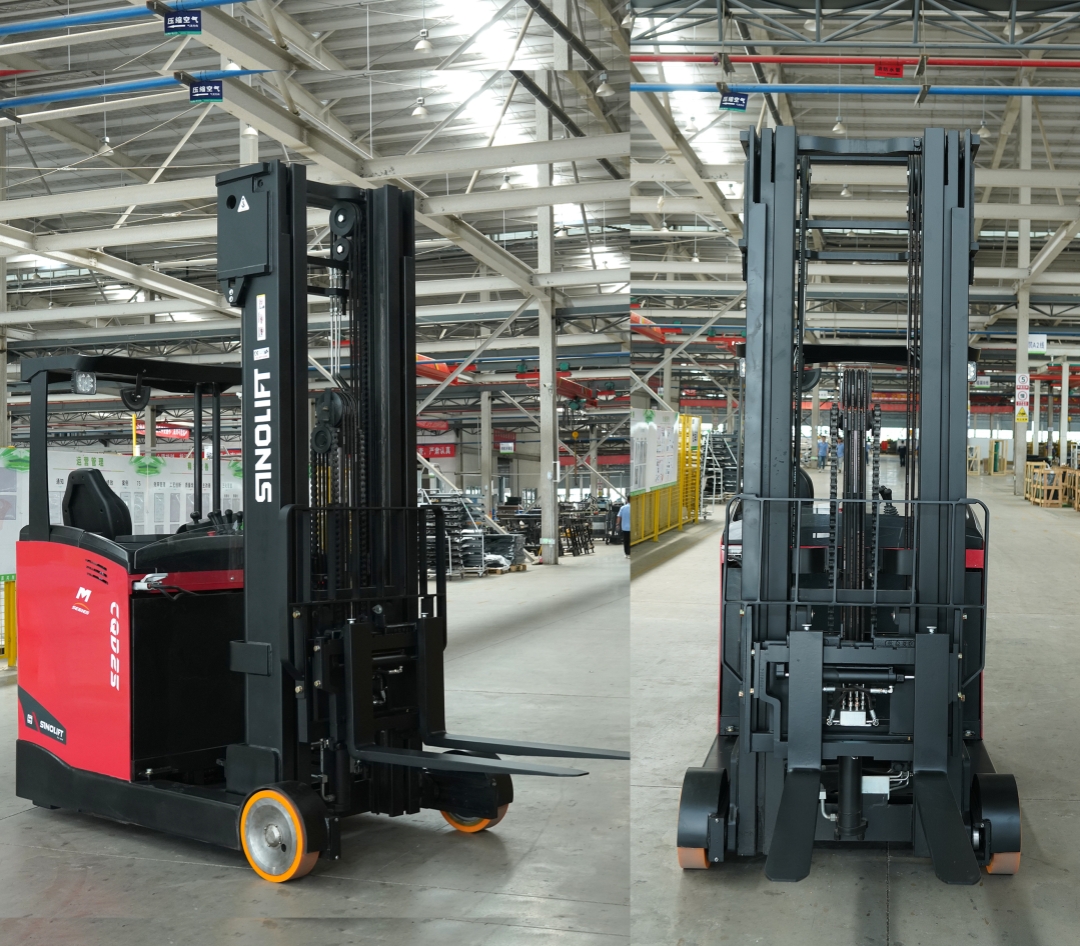
The SINOLIFT range includes stand-on, seated, double-deep and walkie configurations. These serve different workflows: a compact stand-on truck for fast rack cycles should not be selected in the same way as a seated truck for longer travel or a pantograph truck for double-deep storage.
Applications
Where a reach truck is a strong fit
A reach truck is a strong fit when most work takes place inside a warehouse between pallet racks. The typical route starts at an indoor staging area, enters a defined rack aisle, places or retrieves a full pallet and returns to staging. The floor is level, pallet sizes are controlled, and the truck does not need to cross rough yards or steep ramps.
High racking is another clear reason to consider this truck type. The operator needs controlled fork positioning, good mast visibility and a mast configuration that reaches the top storage level without contacting doors, sprinklers, roof members or other overhead structures. Buyers must still request residual capacity—the load permitted at a stated height and load center.
- Single-deep selective pallet racking in an indoor warehouse
- Repeated pallet put-away and retrieval in limited aisle space
- High-level storage where a conventional forklift needs too much turning room
- Distribution, manufacturing, retail, food and spare-parts warehouses with controlled pallets
- Sites that can keep reach-truck aisles clear of pedestrians, carts and loose materials
Warehouse fit
How to check whether a reach truck will fit
Follow the real pallet from receiving to its highest rack location. Start with the largest and heaviest normal pallet—not an empty demonstration pallet.
Measure the load after wrapping because cartons and film may extend beyond the pallet edge. Note which side the forks enter and whether bottom boards, blocks or closed sections can interfere with the forks or support legs.
Measure the narrowest clear distance between rack faces or protectors at the entrance, middle and far end of every critical aisle. Record door heights, the lowest overhead obstruction, the highest beam and the fork height needed to place the pallet with clearance. The WorkSafe Victoria selection guide recommends matching the truck to loads, site conditions, operator abilities and identified hazards rather than choosing from availability alone.
Load and pallet data
- Maximum pallet weight, including pallet and packaging
- Pallet length, width, height and fork-entry direction
- Load overhang, wrapping and stability
- Fork openings and underside pallet construction
Route and rack data
- Clear aisle width after protectors and barriers
- Required fork height and overhead restrictions
- Floor cracks, joints, slopes, water and debris
- Daily travel distance, pallet moves and charging windows
Product options
SINOLIFT models for different indoor workflows
Model ratings are starting points. Final mast, lift height, residual capacity, pallet depth, forks, battery and right-angle stacking aisle must be confirmed for the delivered configuration.
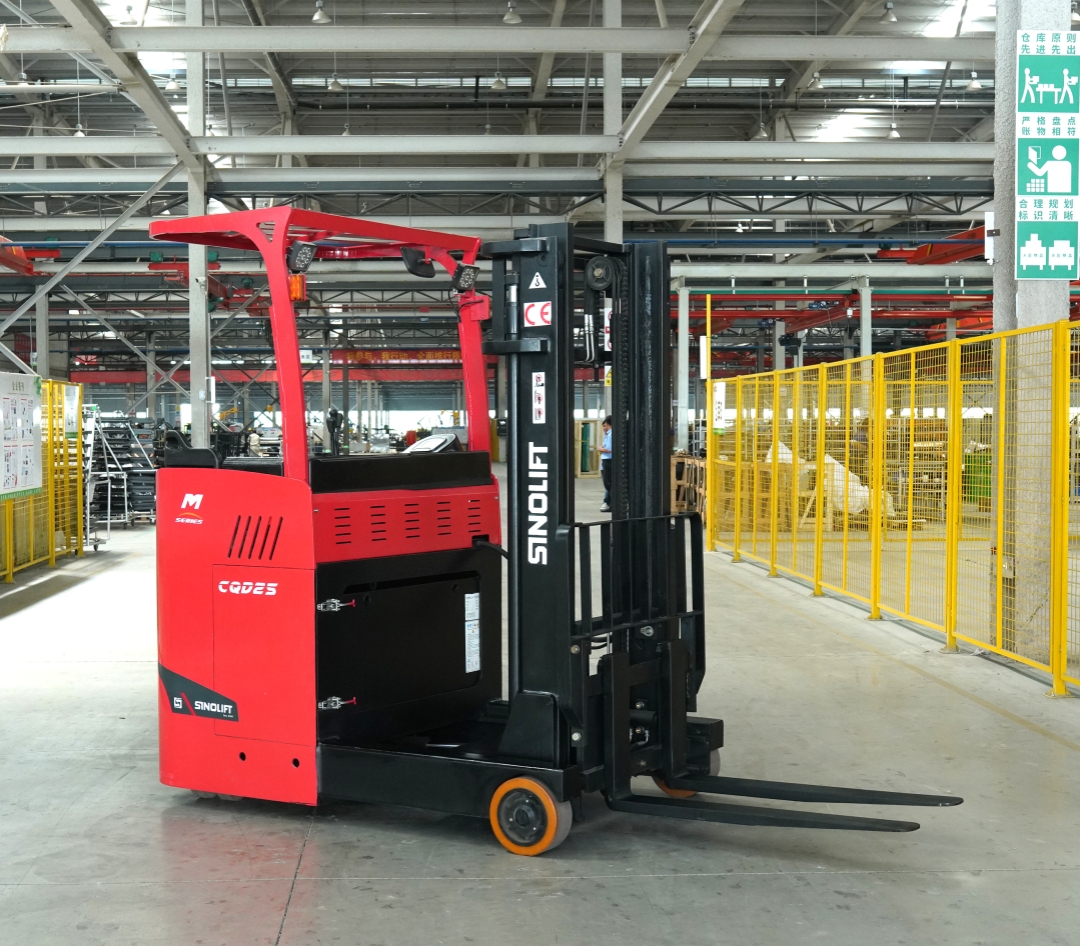
Stand-on reach truck
CQD15B / CQD20B
Compact stand-on layout for repeated rack cycles and frequent operator entry or exit. Published rated loads are 1,500 kg and 2,000 kg at a 500 mm load center.
Seated movable-mast reach truck
CQD25A
A 2,500 kg seated model for longer operating periods and greater travel between receiving, storage and dispatch. Published load center is 600 mm.
Configuration note
Model names should be discussed only after the warehouse data are available. A higher-rated model may have a larger chassis, while a smaller truck may not retain enough capacity at the top rack. Confirm the final technical drawing, capacity chart, mast, battery, fork dimensions and right-angle stacking aisle before ordering.
Product demonstration
What to look for in a useful reach-truck video
A useful demonstration shows the complete job rather than an unloaded truck driving in an open area. Ask to see the operator approach the rack, align the forks, enter the pallet, lift, reach, withdraw, retract, turn and travel with a representative load. It should also show visibility when reversing and when the mast is raised to the highest planned level.
If an on-site trial is not immediately possible, compare the demonstration video with the dimensional drawing and your warehouse photographs. Video can explain the mast, controls, support legs, side shift, camera and battery access, but it cannot replace written confirmation of aisle fit or capacity at height.
Recommended video position
Place the operation video directly here—after readers understand the full stacking cycle and before the safety section. No valid video URL was present in the published article, so the safe embed template is retained as a comment and does not create an empty player.
Safety and operating limits
Plan around trained operators, residual capacity and the real route
Reach trucks are high-lift industrial vehicles and require trained, authorized operators under the rules that apply at the worksite. The load must remain within the capacity shown for the delivered truck and configuration. OSHA's powered industrial truck standard requires safe handling, inspection, training and removal from service when a condition affects safe operation. Local laws may add other requirements.
The warehouse should separate pedestrians from truck aisles wherever practical. Operators need clear rack openings, good lighting, stable pallets and floors free from holes, water, oil, loose wrap and debris. Do not assume a model can work in a yard, on a ramp or inside a trailer unless SINOLIFT approves that exact route and configuration.
Quotation checklist
What to send SINOLIFT for a correct recommendation
Send real operating conditions with photographs or a simple marked drawing. If the warehouse has several pallet sizes or rack zones, list the worst case for each zone rather than one average number.
Load information
- Maximum load weight and load stability
- Pallet dimensions and fork-entry direction
- Required fork height and top-level load
- Fork openings, overhang and packaging
Site information
- Clear rack-to-rack aisle width
- Doors, sprinklers and overhead restrictions
- Floor, slope, dock and route photographs
- Working hours, temperature and charging time
Final selection
Choose the truck around the real warehouse
The best forklift for narrow aisles is the truck that can safely handle the real pallet at the real rack height with repeatable clearance. Choose an electric reach truck for controlled indoor rack work where compact stacking and high lifting are the main needs. Choose a counterbalance forklift when dock work, outdoor travel, mixed surfaces or direct pallet access matter more. Use both when the warehouse contains both types of work.
Ask for the proposed model's capacity chart and dimensional drawing, then arrange a demonstration video or site trial before final approval.
Frequently asked questions
Seven questions buyers ask before choosing a reach truck
What type of forklift is best for a narrow warehouse aisle?
An electric reach truck is usually the best starting point for full-pallet storage in narrow indoor rack aisles. The exact choice still depends on pallet size, lift height, floor condition, required capacity at height and the manufacturer's stacking-aisle data.
Can a reach truck replace a normal forklift?
It can replace a counterbalance forklift for many indoor rack tasks, but it is not a universal replacement. Docks, trailers, yards, rough surfaces, closed pallets and mixed routes may still require a counterbalance forklift.
Can a reach truck work outdoors?
Most reach trucks are designed for smooth, level and dry indoor floors. Limited outdoor use is possible only when the manufacturer approves the model, surface, slope, weather, tires and route.
How do I know whether a reach truck can turn in my aisle?
Use the right-angle stacking aisle value for the exact model, pallet size and entry direction. Then account for rack protectors, load overhang, floor condition and an operating allowance. Confirm the result with a drawing and practical trial.
Is rated capacity enough to choose a reach truck?
No. The truck must retain enough capacity at the required lift height, load center and reach position. Aisle width, mast dimensions, pallet construction, floor condition, battery and attachments also affect selection.
What should a reach-truck demonstration include?
It should show a representative pallet being picked, lifted, reached into the rack, withdrawn, retracted, turned and transported. The operator should also demonstrate visibility, braking, controls, battery access and any camera or height aid.
What information does SINOLIFT need for a quotation?
Send the maximum load weight, load and pallet dimensions, fork-entry direction, required lift height, clear aisle width, floor and route conditions, working hours, temperature, attachments and site photos or drawings.
Talk to SINOLIFT
Send us your pallet, rack and aisle data
Include load weight, pallet size, lift height, clear aisle width and route photos. We can compare the stand-on CQD15B/CQD20B with the seated 2.5 t CQD25A for your application.
How to Choose a 300 kg Paper Roll Lifter for Printing and Packaging: Electric vs. Manual