How to Choose Paper Roll Handling Equipment For Printing Packaging and Converting Plants

Choose the handling method before choosing the power system
Paper roll handling equipment should be selected from the complete transfer task: roll dimensions and surface, pickup and delivery heights, route, machine interface, moves per shift, and required orientation. A V-shaped roll stacker fits a horizontal roll that can be supported from below, while a clamp or core mandrel serves a different handling need.
Choose the PV manual hydraulic model when lifting is occasional and a simple power-free system is preferred. Choose the EPV semi-electric model when repeated vertical lifting makes push-button operation more practical. Both models are manually travelled and must be approved against the actual roll and site.
Which SINOLIFT roll stacker fits your workflow?
These two customized machines support the same basic horizontal-roll task but solve different lifting-frequency needs. Hover over either image—or tap on mobile—to open the matching product page.
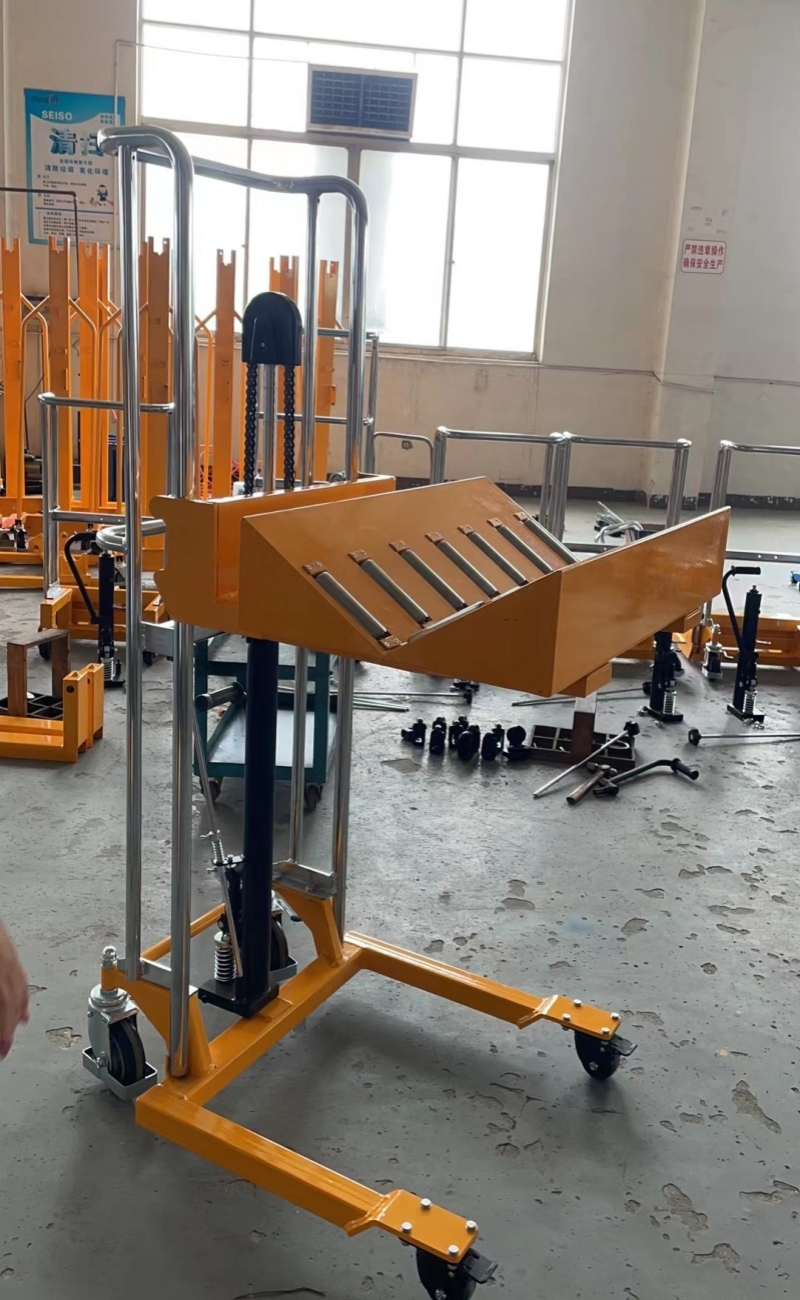
PV Manual Hydraulic Roll Handling Stacker
Best suited to occasional lifting, short level routes, backup stations, and buyers who prefer a simple hydraulic system without a battery or charger.
View PV Details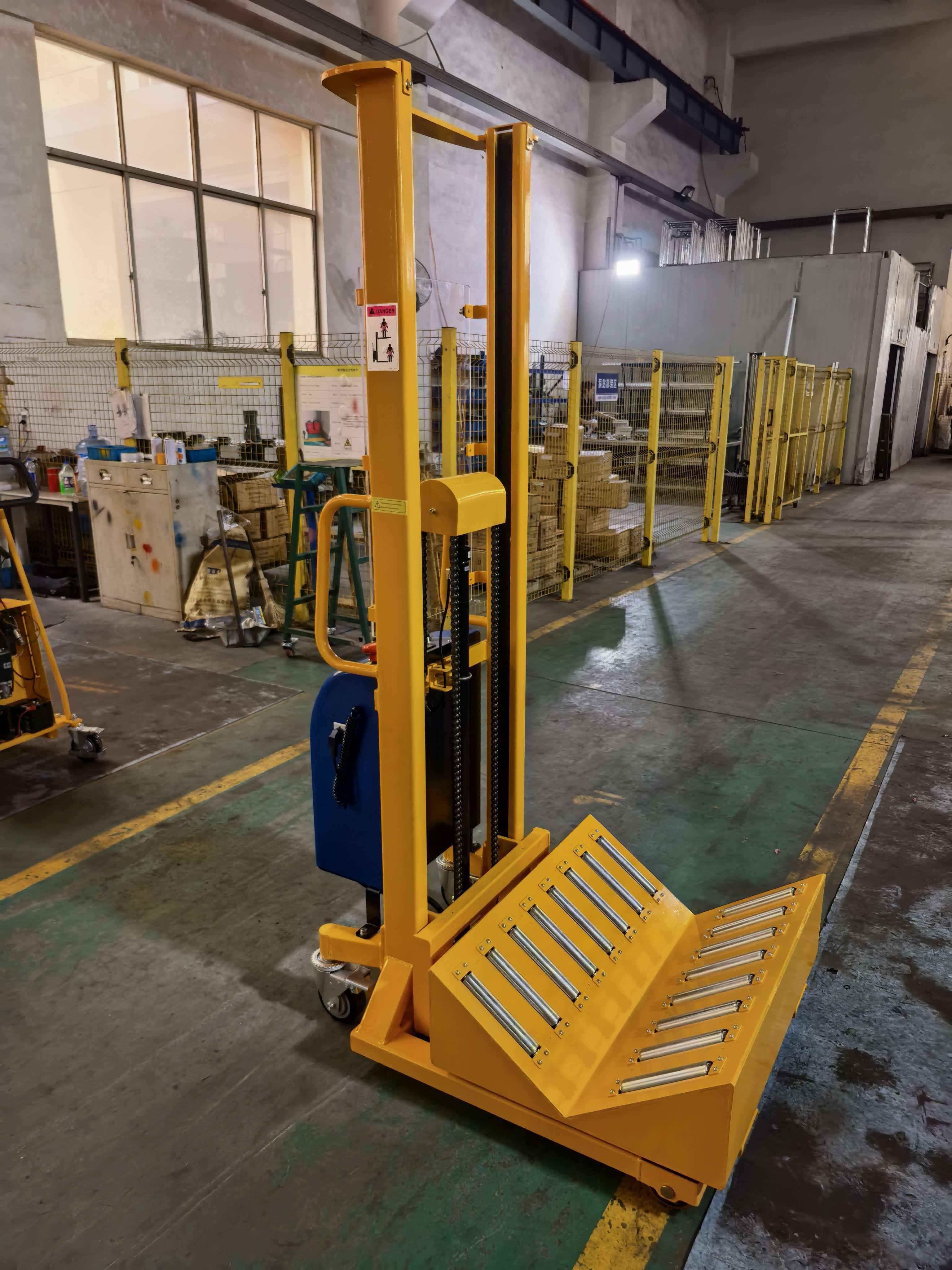
EPV Semi-Electric Roll Handling Stacker
Best suited to repeated vertical lifting and short manual transfers where push-button lift control can reduce pedal work and improve cycle consistency.
View EPV DetailsWhy paper and film rolls need purpose-built equipment
Paper roll handling equipment controls a load that can rotate, shift laterally, deform at its surface, or run away when the floor is not level. A standard flat fork or platform may carry the mass but may not control rolling during acceleration, braking, turning, or lifting. Support shape and transfer method therefore matter as much as nominal capacity.
Paper quality can also be damaged by the wrong contact method. The paper handling and logistics best-practice guide explains that equipment should match the grade, weight, density, dimensions, and point in the logistics chain. For a supported cradle application, buyers should check contact area, roller geometry, restraints, and acceptable product marking.
The correct task definition is a controlled transfer between two known interfaces—for example, storage to a printing press, slitter to packing station, film warehouse to unwinder, or floor pallet to an inspection bench. Each interface has its own centerline height, clearance, approach direction, orientation, and release method.
Collect roll, route, and interface data first
A useful specification begins with measured data rather than a product name. Record the smallest and largest roll, the hardest route, the highest transfer point, and the peak work sequence.
| Input | What to record | Why it changes selection | Evidence to request |
|---|---|---|---|
| Roll | Minimum, typical, and maximum mass, diameter, width, core, and orientation | Defines support geometry, capacity, and overhang | Dimensioned roll drawing and sample |
| Surface | Paper grade, film type, wrapper, softness, cleanliness, and marking limits | Determines allowable contact and roller material | Representative-roll condition check |
| Pickup | Floor, pallet, cradle, rack, or machine height and approach direction | Sets leg clearance and loading method | Pickup-interface drawing |
| Delivery | Final centerline, support height, shaft clearance, and release direction | Sets lift height, mast layout, and positioning method | Machine drawing or site measurement |
| Route | Distance, aisles, turns, doorways, joints, slopes, debris, and crossings | Controls maneuverability, effort, and stopping risk | Loaded route trial |
| Duty | Moves per hour, lifts per shift, peak sequence, and shifts per day | Separates occasional duty from repetitive lifting | Observed cycle log |
| Environment | Temperature, moisture, dust, hygiene, corrosion, and classified areas | Changes material, electrical, and maintenance requirements | Written site-condition schedule |
Choose the support method before the power system
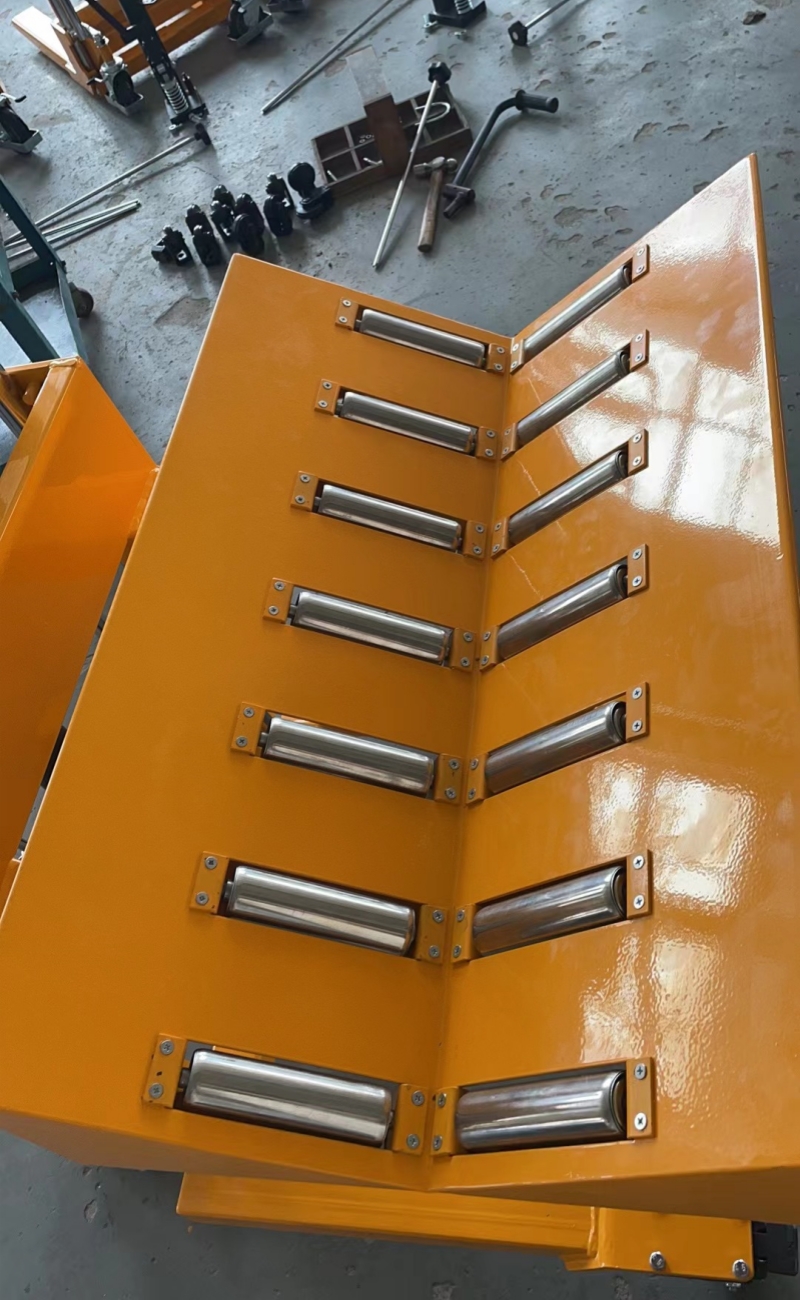
A V-shaped cradle supports a horizontal roll from below, a core mandrel engages the roll bore, an external clamp grips the circumference, and flat forks normally require a pallet or engineered support. These methods are not interchangeable.
- V-shaped cradle: simple support for horizontal rolls, but it does not rotate or grip the load.
- Core mandrel: protects sensitive outer layers, provided core strength and engagement are verified.
- External clamp: controls orientation, but incorrect clamping pressure can damage the roll.
- Pallet or platform: suits restrained or palletized rolls when fork entry and blocking are approved.
Browse SINOLIFT’s roll and reel handling equipment when the process requires rotation, clamping, core expansion, or another specialized interface.
Compare the PV and EPV by work pattern
The two models address the same basic roll-support task but differ in vertical actuation. Both are manually pushed and steered.
| Selection factor | PV manual hydraulic | EPV semi-electric | Decision rule |
|---|---|---|---|
| Lift method | Foot-pedal hydraulic lift | Push-button electric lift | Choose EPV when repeated pumping is the bottleneck |
| Travel | Manual | Manual | Test both on the real route at maximum approved load |
| Rated load | 400 kg | 400 kg | Confirm roll geometry and center of gravity as well as mass |
| Lift options | Approximately 0.85–2.0 m | Approximately 0.85–2.0 m | Specify the required machine or support centerline |
| Utilities | No battery or charger | Battery, charger, motor, and controls | Include charging, inspection, and replacement planning |
| Typical duty | Occasional lifts and simple indoor transfers | Repeated lifts with short manual travel | Consider powered travel if route effort remains high |
When PV is the better fit
The PV manual roll handling stacker usually fits occasional lifting, short level paths, backup stations, maintenance areas, and low-frequency product changes. Its power-free hydraulic design simplifies charging and electrical maintenance.
Do not select PV only because its initial price is lower. Observe several complete cycles with the heaviest approved roll, including loading, pedal access, steering, stopping, lowering, and parking.
When EPV is the better fit
The EPV semi-electric roll handling stacker usually fits repetitive vertical lifting with short manual travel. Push-button control can reduce pedal work during film-roll changes, paper converting, inspection, and line-side replenishment.
EPV remains manually travelled. Electric lifting does not solve long routes, ramps, damaged floors, or frequent tight turns; battery and electrical-system maintenance also become ownership requirements.
Match the equipment to the application
Printing plants
Confirm press-frame clearance, loading centerline, guard position, operator visibility, and whether the V-platform can align and release the core without manual levering.
Flexible packaging and film converting
Prioritize surface protection and frequent changeovers. The final drawing should show roller spacing, contact material, roll overhang, and travel restraints.
Paper converting and labels
Treat multiple-size duty as an approved operating envelope. Test the smallest, largest, narrowest, and widest rolls—including the hardest center-of-gravity combination.
Warehouses and line-side stores
Measure the whole route, including thresholds, floor joints, crossings, turning space, and parking. Long routes or slopes may justify powered travel.
Validate access around the entire machine
This rear three-quarter view is best placed beside the application section because it lets buyers examine the EPV power housing, mast, handle, wheel arrangement, and overall access—not just the V-platform.
If the job needs powered travel, long-distance transport, roll rotation, external clamping, core expansion, or accurate axial insertion, return to the workflow definition. Alternatives may include a pallet stacker, forklift attachment, or electric pallet truck.
Use current evidence—not intuition—to assess handling risk
Mechanical assistance is valuable because roll handling combines awkward geometry with pushing, pulling, lifting, and restraint. The CCOHS manual materials handling guide identifies excessive weight, poor grip, unstable contents, awkward height, repetition, and difficult workplace conditions as risk factors. Its guidance recommends selecting equipment for the task, training operators, inspecting equipment, and generally pushing rather than pulling.
The OSHA flexography eTool identifies heavy lifting, forceful gripping, bending, and manual roll transfer as hazards in printing. HSE statistics for 2024/25 report 511,000 workers with work-related musculoskeletal disorders and 7.1 million working days lost in Great Britain. These figures do not predict one machine’s risk, but they support measuring force and repetition instead of relying on a single empty demonstration.
ISO 3691-5 defines safety requirements and verification methods for pedestrian-propelled industrial trucks within its stated scope. Buyers must also identify destination-country laws, operator training, marking, inspection, and documentation requirements for the final customized configuration.
Run a representative-load acceptance test
The acceptance test should reproduce the hardest approved task with the intended operator, actual route, real pickup and delivery points, and most demanding approved roll.
- Verify the approved drawing, nameplate, rated load, lift range, overall dimensions, electrical data, wheel arrangement, and documented roll envelope.
- Inspect the mast, chain, cylinder, V-platform, rollers, fasteners, wheels, brakes, controls, guards, wiring, battery, charger, labels, and hydraulic system.
- Run empty lift and lowering cycles, then repeat with the representative roll while checking smooth motion, controlled descent, leakage, noise, sway, and roll movement.
- Complete the real route and record starting, sustained, turning, and stopping effort, including joints, narrow points, and operator visibility.
- Confirm the machine reaches the required centerline, clears frames and guards, and releases the roll without improvised lifting, levering, or hand restraint.
- Check parking stability and brake function, then record photographs, measurements, test results, training, and the accepted final configuration.
Specify customization in measurable terms
Include in the RFQ
- Minimum, typical, and maximum roll mass and dimensions
- Core size, roll orientation, surface, wrapping, and marking limits
- Pickup and delivery heights, approach, release, and clearances
- Route distance, floor condition, gradients, and aisle dimensions
- Moves per hour, lifts per shift, and peak sequence
- Destination standards, language, electrical supply, manuals, and spares
Compare the complete cycle
For PV, include operator time, pedal cycles, inspection, hydraulic service, chains, rollers, casters, brakes, and seals. For EPV, include the same mechanical items plus charging, battery replacement, charger, motor, wiring, switches, and controls.
When practical, observe at least 20 representative cycles. Record pickup-to-release time and delays caused by alignment, steering, floor resistance, charging, or manual adjustment. This shows whether electric lift solves the real bottleneck—or whether another interface or powered travel would matter more.
Paper roll handling equipment FAQ
What is paper roll handling equipment?
How do I choose between a V-shaped cradle and a roll clamp?
Is the EPV a fully electric roll stacker?
Can PV and EPV handle any roll below 400 kg?
Can a V-platform load a roll directly onto a printing or converting machine?
What maintenance does paper roll handling equipment need?
What should I send the supplier before requesting a custom quotation?
Reference links
Need a roll stacker matched to your actual workflow?
Send the roll dimensions and weight, pickup and delivery heights, route photographs, application video, and required cycle rate. SINOLIFT can use this information to evaluate whether the PV, EPV, or another customized handling method fits the task.
Back to top ↑
How to Choose a Counterbalanced Stacker: A Practical B2B Buyer’s Guide