Maximizing Warehouse Space: VNA Forklifts vs. Regular Electric Forklifts for Narrow Aisles

In modern logistics, space utilization and operational efficiency are the core drivers of profitability. Warehouse rents continue to skyrocket globally. Inventory densities are increasing rapidly. Consequently, more businesses are transitioning to narrow aisle configurations. Choosing the right equipment for these tight spaces is absolutely critical. Which machine truly reigns supreme in restricted spaces? Is it the advanced three-way VNA forklift, or the traditional regular electric forklift? Let’s break down the capabilities of each. We will help you make an informed, data-driven decision.
Understanding the Three-Way VNA Forklift
A Very Narrow Aisle (VNA) forklift is a specialized machine. It is often referred to as a three-way forklift. Engineers designed it explicitly for high-density storage environments. Unlike conventional models, the defining feature of VNA Forklifts is their uniquely rotating turret head. The forks can rotate a full 90 degrees to the left or right. This innovative design means the operator can retrieve, stack, and transport pallets without ever needing to turn the entire vehicle body.
Operating seamlessly in aisles as narrow as 1.5 to 1.6 meters, VNA trucks dramatically shrink the wasted space between racks. Many advanced models are also integrated with magnetic or wire guidance systems. These guidance technologies ensure flawless precision. They also guarantee maximum safety at extreme lifting heights, which can sometimes reach up to 17 meters. By eliminating the need for wide turning circles, these machines completely redefine what is possible in warehouse geometry.
The Classic Choice: Regular Electric Forklifts
Standard electric forklifts remain the universal workhorses of the material handling world. This category includes popular models like counterbalance trucks and electric reach trucks. They feature a straightforward, reliable design. They are incredibly flexible across various daily tasks. Furthermore, they boast lower initial acquisition costs and relatively simple maintenance requirements.
However, their maneuverability comes with a distinct physical limitation. A regular electric forklift must turn its entire body to face the racking to deposit a load. Therefore, it requires a significantly larger turning radius. Standard models typically need an aisle width of at least 2.8 to 3.5 meters to operate safely and effectively. In high-density warehouses where every square meter counts, this wide aisle requirement represents a massive loss of potential storage volume.

The Head-to-Head Comparison
To truly understand which machine fits your operation, let's look at how these two contenders match up across crucial operational metrics.
| Feature | VNA Forklifts (Three-Way) | Regular Electric Forklifts |
| Aisle Width Required | ~1.6 meters | 2.8 - 3.5 meters |
| Max Lift Height | Up to 17 meters | Typically up to 7-8 meters |
| Space Utilization | Increases capacity by 20%-30% | Standard baseline capacity |
| Vehicle Turning | Not required (Forks rotate 180°) | Entire vehicle must turn |
| Initial Investment | Higher | Lower |
Space Utilization and Efficiency
The primary battleground between these two machines is spatial efficiency. By narrowing aisles from 3.5 meters down to 1.6 meters, VNA Forklifts can instantly increase a warehouse's total storage capacity by 20% to 30%. This metric is crucial for businesses facing high land costs. Additionally, VNA machines offer faster retrieval speeds in tight confines because they travel linearly down the aisle without complex maneuvering. Regular electric forklifts, while slower in tight aisles, shine when moving goods across vast, open floor plans.
Costs and Maintenance Considerations
Budget considerations often dictate equipment purchases. Standard electric forklifts are undeniably cheaper upfront. They are easier to source. Their parts are universally available. Training operators takes less time. VNA Forklifts demand a much higher initial investment. They also require specialized operator training due to the complexities of high-altitude handling and turret controls. However, the long-term return on investment (ROI) for VNA trucks is substantial. The ability to store 30% more goods in the exact same building often negates the need for costly facility expansions.

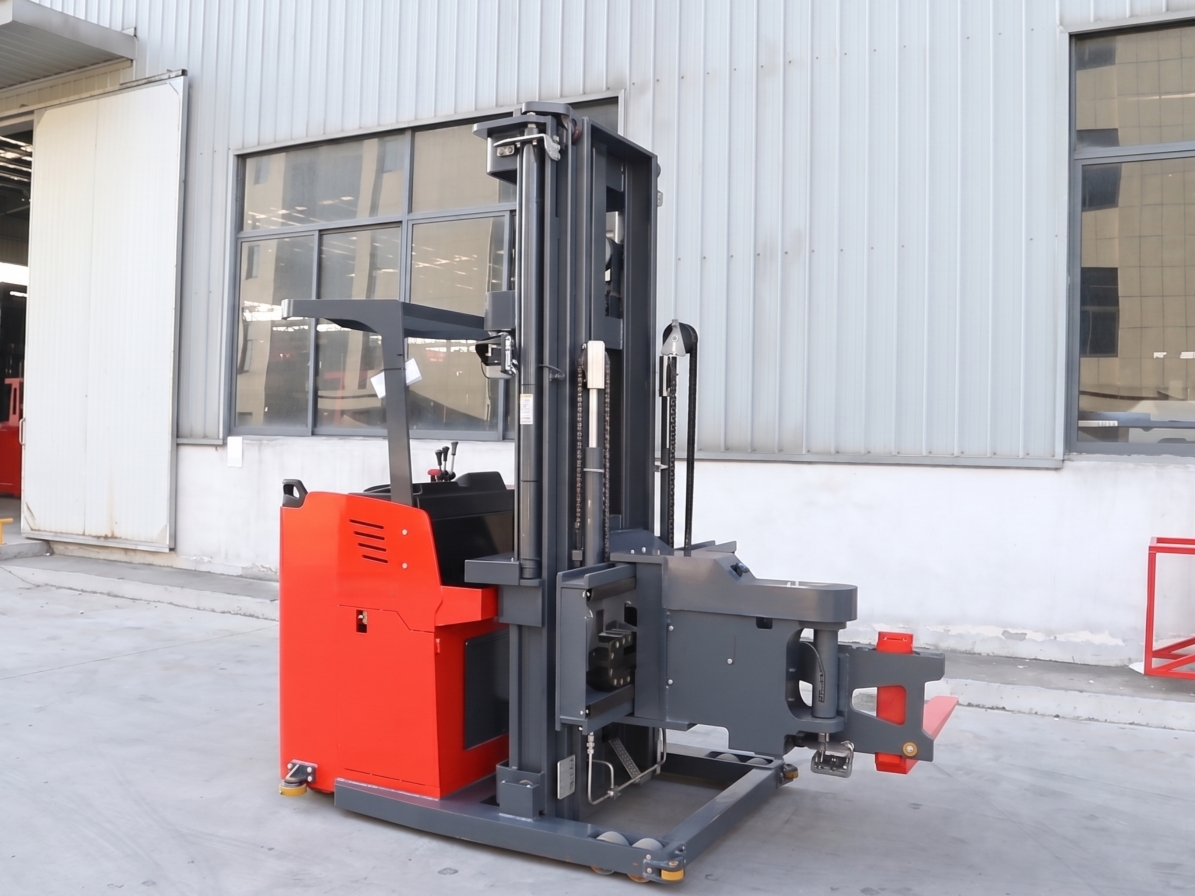
Product Spotlight: SINOLIFT 1.2-1.6t MC Series Man-Down VNA Turret Truck
If you are looking to conquer narrow aisles and maximize your vertical storage, our MC Series is the ultimate solution. The SINOLIFT MC Series Stand-on 3-Way Pallet Stacker is specifically engineered to maximize your warehouse capacity by operating efficiently in ultra-narrow aisles. Combining ergonomic driving comfort with robust power, it is the ideal solution for inventory picking and dense storage management in mid-to-high level warehousing environments.
-
180° Rotating & Side-Shifting Forks: Featuring a 180-degree rotation and side-shift mechanism, the forks offer ultimate flexibility. Operators can seamlessly stack and unload goods on both sides of the racking without ever needing to steer the vehicle body within the narrow aisle.
-
Ultra-Narrow Aisle Capability: Designed to maximize your warehouse footprint, this truck requires a minimum stacking aisle width of just 1.6 meters. By minimizing wasted space, it allows for denser racking setups and substantially boosts your overall storage capacity.
-
10-Meter High Lift Performance: Reaching an impressive maximum lift height of 10 meters, the robust mast design guarantees excellent stability. Furthermore, it maintains its full load capacity up to 6 meters, delivering outstanding performance even under extreme heavy-duty conditions.
-
High-Definition Vision System: A high-definition fork camera system comes equipped as a standard feature, providing a crystal-clear and expanded field of view. This visual aid ensures that high-elevation stacking operations remain both exceptionally safe and highly efficient.
-
Ergonomic Body Support: The truck features thoughtfully designed backrests, leg cushions, and armrests. This comprehensive ergonomic support minimizes physical strain, drastically reducing operator fatigue during demanding, long-duration shifts.
-
Intuitive Control Layout: All control levers, the dashboard, and operational switches are arranged according to strict ergonomic principles. This intuitive layout places everything right at the driver's fingertips, significantly enhancing both comfort and handling flexibility.
Ideal Applications for VNA Technology
Certain industries benefit disproportionately from the dense storage capabilities of three-way forklifts.
-
E-commerce Fulfillment Centers: These facilities handle massive SKU counts. They require incredibly dense slotting. VNA Forklifts enable rapid picking and maintain high turnover rates.
-
Cold Storage Facilities: Refrigerated warehouse space is astronomically expensive to build and run. Utilizing VNA machines allows operators to pack maximum inventory into smaller chilling zones, saving huge amounts of energy.
-
High-Bay Storage: Warehouses utilizing tall racking systems rely on VNA trucks. When paired with wire guidance systems, they enable safe, semi-automated operations at extreme heights.
-
Urban Distribution Hubs: City-center warehouses fight exorbitant real estate costs. Upgrading to a VNA system is far cheaper than expanding the physical building footprint.
Prioritizing Warehouse Safety
Operating heavy machinery always requires a strict focus on safety protocols. Regular electric forklifts are generally easier to master. Their wide turning radius provides a natural buffer zone for pedestrians. However, VNA Forklifts operate in extremely confined spaces. Operators must undergo specialized training. They need to understand high-altitude load balancing. Maintaining perfect spatial awareness is non-negotiable. Fortunately, modern VNA trucks feature advanced safety tech. End-of-aisle braking systems prevent collisions. HD cameras eliminate dangerous blind spots. When managed correctly, narrow aisle operations are incredibly safe and highly productive.
Making the Right Choice for Your Warehouse
Choosing between VNA Forklifts and regular electric models comes down to your specific operational landscape. If your facility features towering racks and tightly packed aisles, a three-way VNA forklift is the undisputed champion. It allows you to unlock maximum efficiency within a constrained physical footprint. The initial cost is easily offset by the massive gains in storage volume.
Conversely, if your warehouse boasts sprawling floor space, wide lanes, and diverse daily tasks, the standard electric forklift might be the smarter play. They offer unmatched versatility for general loading and unloading. They are also highly cost-effective for small to medium enterprises.
For those planning future automation upgrades, designing a narrow aisle layout now makes perfect sense. It will seamlessly pave the way for advanced VNA integration down the line. Evaluate your ceiling height carefully. Assess your storage density goals accurately. Match your equipment strategy to your long-term business vision. Ultimately, the right forklift doesn't just move pallets; it transforms your entire logistical workflow.

Navigating the Future of Logistics: The Unstoppable Rise of the VNA Forklift Truck
5 Game-Changing Advantages of VNA Forklifts for Modern Warehouses