Ergonomics & Safety: Reducing Workplace Injuries with the Right Manual Handling Equipment
The Hidden Cost of "Making Do"
Have you ever calculated the true cost of a single workplace injury?
Most business owners look at the immediate expenses: medical bills and workers' compensation claims. However, these are just the tip of the iceberg. The real financial damage often lies beneath the surface.
Consider the lost production hours while a skilled worker recovers. Think about the time spent training a temporary replacement. Factor in the potential rise in insurance premiums and the subtle, yet damaging, drop in team morale. When one person gets hurt, the whole team slows down.
In the logistics, warehousing, and manufacturing sectors, the statistics are clear. Musculoskeletal disorders (MSDs)—such as back strains, shoulder pain, and joint damage—are among the most common reasons for missed workdays.
Often, these injuries stem from a simple cause: using the wrong equipment for the job.
Investing in the correct, ergonomically designed manual winch stacker is not merely an operational expense. It is a critical investment in your workforce’s health and your company’s long-term efficiency.
Understanding the Risks and Myths
Before we look at solutions, we must understand the problem. Manual material handling is necessary, but it is fraught with risk if not managed correctly.
Common Hazards in the Warehouse
- Overexertion: Excessive force required to push, pull, or lift heavy loads manually.
- Awkward Postures: Bending, twisting, or reaching to access loads, which puts severe stress on the spine.
- Repetitive Motion: Doing the same lifting motion hundreds of times a day, leading to cumulative fatigue.
- Crushing & Impact: Heavy loads falling, or equipment tipping over due to instability.
The "Low-Tech" Myth
There is a dangerous misconception in our industry. Many people believe that because manual equipment (like hand stackers) does not have a motor, it is "low-tech" and requires little thought to purchase.
This is false.
Using a generic lifter for a specialized task is a safety hazard. Using a stacker that is too heavy for a light job causes fatigue. Using a narrow stacker for a wide load causes tipping. The engineering behind a manual winch stacker is precise. It is designed to bridge the gap between human physical limits and the demands of the job.
What Is a Material Lift Winch Stacker?
To clarify, a material lift winch stacker is a manually operated tool designed to lift, lower, and position heavy items. These can range from HVAC units and pallets to construction materials.
They are essential for:
- Warehouse stocking
- Maintenance and repair jobs
- HVAC installations
- Retail inventory management
A high-quality unit must be strong, compact, and easy to transport. Most importantly, it must be matched to the specific environment it operates in.
Three Scenarios, Three Solutions
Safety is not "one size fits all." Different work environments present different ergonomic challenges. Below, we break down three common risk scenarios and how specific Sinolift solutions address them.
Scenario 1: High Frequency & Light Loads
The Risk: Cumulative Fatigue
Imagine a technician working in a large workshop. They need to move motors, boxes, or parts between workbenches multiple times an hour. The loads aren't massive—perhaps 50kg to 100kg—but the frequency is high.
If the equipment itself is heavy and difficult to drag around, the operator gets tired. Fatigue is the enemy of safety. When a worker is tired, they cut corners. They stop using the lift and start lifting by hand, leading to back injuries.
The Solution: The WFH Series
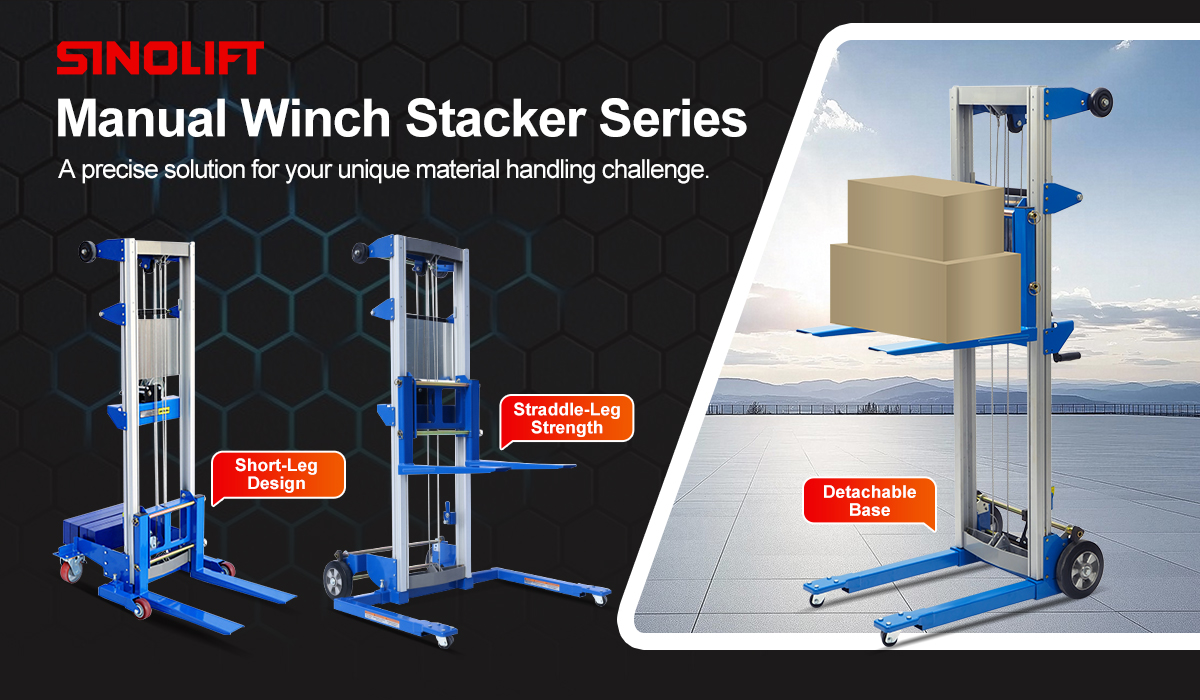
For these fast-paced environments, you need equipment that feels like an extension of the operator. This is where the WFH Series Manual Hand Winch Stacker excels.
- Reducing Physical Strain: The most striking feature of the WFH series is its weight. Starting at just 51kg, it is incredibly lightweight. A single operator can maneuver it around corners and obstacles without fighting the machine. This significantly reduces the "push/pull" force required, saving the operator’s energy for the actual work.
- One-Person Operation: It is designed for autonomy. The smooth-swivel casters allow for precise positioning near workbenches or shelves.
- Safety First: Despite its light frame, it doesn't compromise on control. It features a high-quality manual winch with a safety self-locking mechanism. If the operator lets go of the handle, the load stops instantly. There is no risk of the handle spinning out of control or the load slipping.
By choosing a lightweight tool for lightweight jobs, you remove the frustration and physical toll of dragging heavy machinery, effectively preventing fatigue-related accidents.
Heavy, Wide, or Irregular Loads
The Risk: Instability and Tipping
Now, let’s look at a different scenario. You are in a distribution center handling wide pallets, or perhaps a garden center moving bulky crates. The load is heavy—over 200kg—and physically wide.
Using a standard, narrow-base stacker here is dangerous. If the center of gravity shifts, a narrow stacker can tip sideways. This poses a severe crushing risk to the operator and anyone nearby. Furthermore, standard stackers often cannot wrap around the bottom of a wider pallet, forcing operators to balance loads precariously on the tips of the forks.
The Solution: The SW Series
Stability is the foundation of safety. For bulky challenges, the SW Series Manual Hand Winch Stacker with Straddle Legs is the engineered answer.
- The Wide Base Advantage: The "SW" stands for superior width and stability. The straddle legs combined with a 1100mm fork width create a wide, solid geometric base. This footprint anchors the unit to the ground, virtually eliminating the risk of sideways tipping when handling wide loads.
- Confident Lifting: When an operator sees a stable base, they work with confidence. The SW series can handle loads up to 227kg. It allows the operator to straddle the pallet, ensuring the load is lifted from its center of gravity, not the edge.
- Portability: Remarkably, despite this heavy-duty stability, the unit remains portable. It features a detachable chassis, meaning it can be broken down and loaded into a light truck. This makes it perfect for delivery drivers who need to unload heavy, wide items at a client’s site safely.
By matching the equipment width to the load width, you eliminate the number one cause of stacker accidents: instability.
The "Impossible" Tight Space
The Risk: Crushing and Pinch Points
The third scenario is common in modern, crowded facilities. Think of a narrow aisle in a retail stockroom, a cramped production line, or a loading zone where every inch counts.
In these spaces, "straddle legs" (like those on the SW series) become a liability. They block the stacker from getting close to a wall or a workbench that has no clearance underneath. Operators often try to compensate by leaning over the equipment or twisting their bodies to reach the load. This causes severe spinal strain and increases the risk of getting pinned between the machine and a rack.
The Solution: The BC Series
When you have no room to move, you need precision. The BC Series Counterbalance Hand Winch Stacker transforms how you work in confined areas.
- Zero Obstruction: The defining feature of the BC Series is the counterbalance design. It has no front straddle legs. This means you can drive the unit right up to a loading dock, a shelf, or a workbench obstacle. There are no legs to hit the wall before the forks do.
- Vertical Mastery: It offers an impressive 3.0m lifting height. In tight storage rooms, the only way to go is up. This stacker allows you to utilize vertical space safely without needing a massive forklift.
- Ergonomic Visibility: Because the unit is compact and lacks protruding front legs, the operator has a clear view of the load and the forks. This visibility is crucial in avoiding collisions in narrow aisles. The short leg length allows for a tighter turning radius, reducing the chance of the operator getting stuck or crushed against shelving.
- Powerful Capacity: Despite its compact size, the counterweight allows it to lift 181kg with complete stability.
For the tightest spots, the BC Series removes the physical barriers that force operators into unsafe postures.
Beyond the Product—Building a Safety Culture
Purchasing the right manual winch stacker—whether it’s the lightweight WFH, the stable SW, or the compact BC—is the most significant step toward a safer workplace. However, equipment is only as safe as the person using it.
To truly maximize the return on your investment and protect your team, consider these operational best practices:
1. Respect the Load Limit
Every Sinolift product has a clearly defined load capacity (e.g., 181kg or 227kg). Never attempt to counterbalance an overload by having another worker "hold it down." Overloading is the primary cause of cable failure and structural warping.
2. Inspect Before Use
A manual winch is a simple, reliable mechanism, but it needs a glance.
- Check the cable for fraying.
- Ensure the casters roll smoothly (stuck wheels cause back strain).
- Test the auto-brake winch without a load before lifting heavy items.
3. Center the Load
Always place the goods in the center of the forks. An off-center load creates uneven stress on the mast and can cause the unit to twist. The SW Series makes this easier for wide loads, but the principle applies to all models.
4. Proper Body Mechanics
Even with the best equipment, remind staff to:
- Push, don’t pull (it uses body weight rather than arm muscles).
- Keep a straight back.
- Wear safety shoes to protect against rolling wheels.
Conclusion: Your Partner in Safety
Workplace safety is not about luck. It is about preparation.
By replacing outdated, heavy, or ill-fitting equipment with modern ergonomic solutions, you send a powerful message to your team: "We value your safety and your health."
Whether you need the agility of the WFH Series, the broad stability of the SW Series, or the precision access of the BC Series, Sinolift provides the engineering required to turn hazardous tasks into routine operations.
Don't wait for an accident to reveal the gaps in your safety protocol.
Would you like us to help you assess your current workspace and recommend the exact model that fits your workflow?
Contact the Sinolift Team Today. for a personalized consultation or to request a quote. Let’s make your workplace safer, together.
For professional product selection guidance or technical support, our expert team is at your service:
Contact Information:
✉ Email: shanghai@sinoliftcorp.com
☎ Phone/WhatsApp: +86 13918731490
We provide:
• Customized equipment recommendations
• Detailed product specifications
• On-site technical consultation
• After-sales support
Get your tailored material handling solution today!
Why Switching to a Lithium Battery Forklift is the Smartest Financial Move for Your Warehouse
Mastering the Terrain: A Buyer’s Guide to 2WD vs. 4WD Rough Terrain Forklifts