Solving the Logistical Puzzle: A Guide to Efficient Media Roll Management
In modern production facilities, efficiency is often measured by how quickly materials move from storage to the machine. For businesses dealing with wide-format print media, textiles, or industrial films, this movement is rarely simple. The "media roll" is a bulky, heavy, and delicate asset that defies standard storage and transport logic.
In a busy workshop, space is money. To maximize output, machines are often placed close together, leaving narrow paths for transport. This creates a challenging environment where operators must move rolls—some reaching up to 5 meters in length—without damaging the material or risking personal injury. This article looks at the practical side of managing these heavy cylindrical loads and the technology that makes it possible.
The Hidden Costs of Poor Roll Handling
When we look at the daily operations of a print shop or a textile factory, the actual "work" happens when the machine is running. However, a significant amount of time is wasted in the preparation phase. If the process of getting a media roll onto a machine is difficult, the entire production schedule suffers.
Why Manual Handling Fails
Many workshops still rely on two or three people to manually lift a roll and slide it onto a spindle. This is problematic for several reasons. First, human strength is inconsistent. A slight slip by one person puts the entire weight on the other, leading to immediate back strain or dropped loads. Second, manual lifting lacks the precision required for modern digital printers. If a roll isn't perfectly aligned with the machine's intake, the operator spends extra time repositioning it, which leads to machine idle time.
The Problem of Cylinder Dynamics
Unlike a flat box or a pallet, a roll is inherently unstable. It wants to move. On a flat floor, a 5-meter roll can easily roll away if not secured. During transport, the momentum of a heavy cylinder can make it difficult to stop or turn. This "dynamic" nature of the load requires specialized equipment that can lock the roll in place, ensuring it remains stationary until it is ready to be loaded onto the machine.
Waste and Material Sensitivity
The outer layers of a media roll are the most vulnerable. Even a small impact against a doorway or a machine frame can ruin several meters of material. In the textile industry, a "bruised" roll can lead to inconsistencies in the weaving or dyeing process. In the world of high-speed printing, a dented edge can cause a paper jam that stops a million-dollar press. These "hidden costs" of damaged materials often exceed the cost of professional handling equipment within just a few months.
Defining the Media Roll Lifter
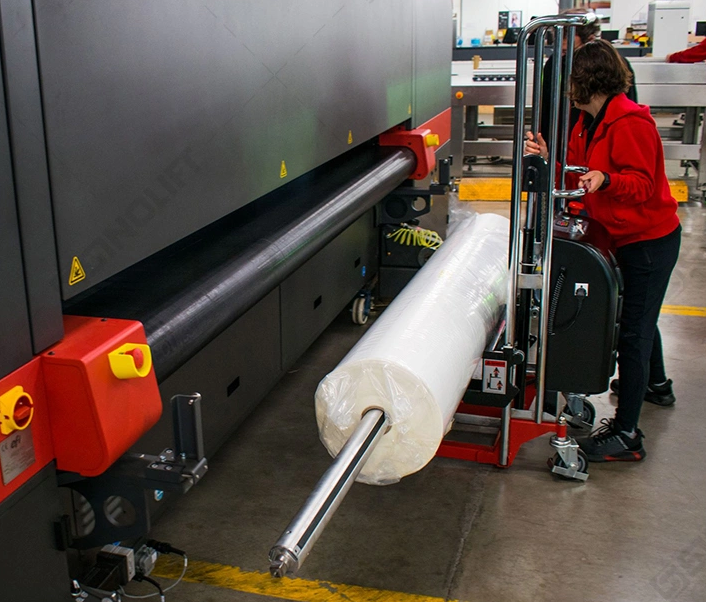
A media roll lifter is a specialized transport tool designed to bridge the gap between storage and production. While it shares some visual similarities with a stacker, its functionality is entirely different. The core of the machine is the cradle—a specialized fork system shaped to hold a cylinder.
The lifter is designed to be a "force multiplier." It takes the physical burden off the human operator and places it on a stable, mechanical frame. By using a specialized lifter, a single employee can handle rolls that would normally require a team. This not only improves safety but also allows for better labor allocation across the workshop.
Most importantly, these lifters are designed with a "zero-turn" philosophy. Because they are used in tight spaces, they feature high-quality swivel casters that allow the machine to rotate within its own footprint. This makes them indispensable for workshops where every square inch of floor space is occupied by equipment.
Step-by-Step: Mastering the Lifter Operation
Using a media roll lifter is straightforward, but achieving maximum efficiency requires a specific technique. Here is how to integrate the tool into your daily workflow.
Initial Positioning
Always approach the roll from the center. If you are picking a roll up from a storage rack or the floor, align the lifter's cradle with the midpoint of the roll. For a 5-meter roll, being off-center by even half a meter can create an imbalance that makes steering difficult.
Securing the Load
Once the cradle is under the roll, use the tilting stop device. This is a critical safety feature that prevents the roll from sliding forward or backward during transport. Before moving, ensure the roll is firmly seated in the "V" or grooved tray of the lifter.
Navigating the Shop Floor
When moving through the workshop, pull rather than push if you need better visibility. The polyurethane (PU) wheels are designed to glide over industrial floors without leaving marks, but they can be sensitive to large debris. Keep your path clear of offcuts or packing materials. If you encounter a narrow turn, use the swivel casters to pivot the rear of the lifter; this allows you to "snake" the long roll through tight gaps.
The Loading Sequence
When you reach the machine (such as a large-format printer), raise the lifter to the height of the machine's loading arms. It is best to raise the roll slightly higher than the target and then slowly lower it into position. This "gravity-assisted" alignment is much easier on the operator and the machine than trying to lift the roll upward into a bracket.
Maintenance and Care
To keep the lifter operating smoothly, the hydraulic cylinder should be kept clean. For electric models, follow a "charge-at-night" routine to ensure the battery is always at full capacity when the morning shift begins.
Advanced Tools for Professional Handling: The PFM and EFM Series
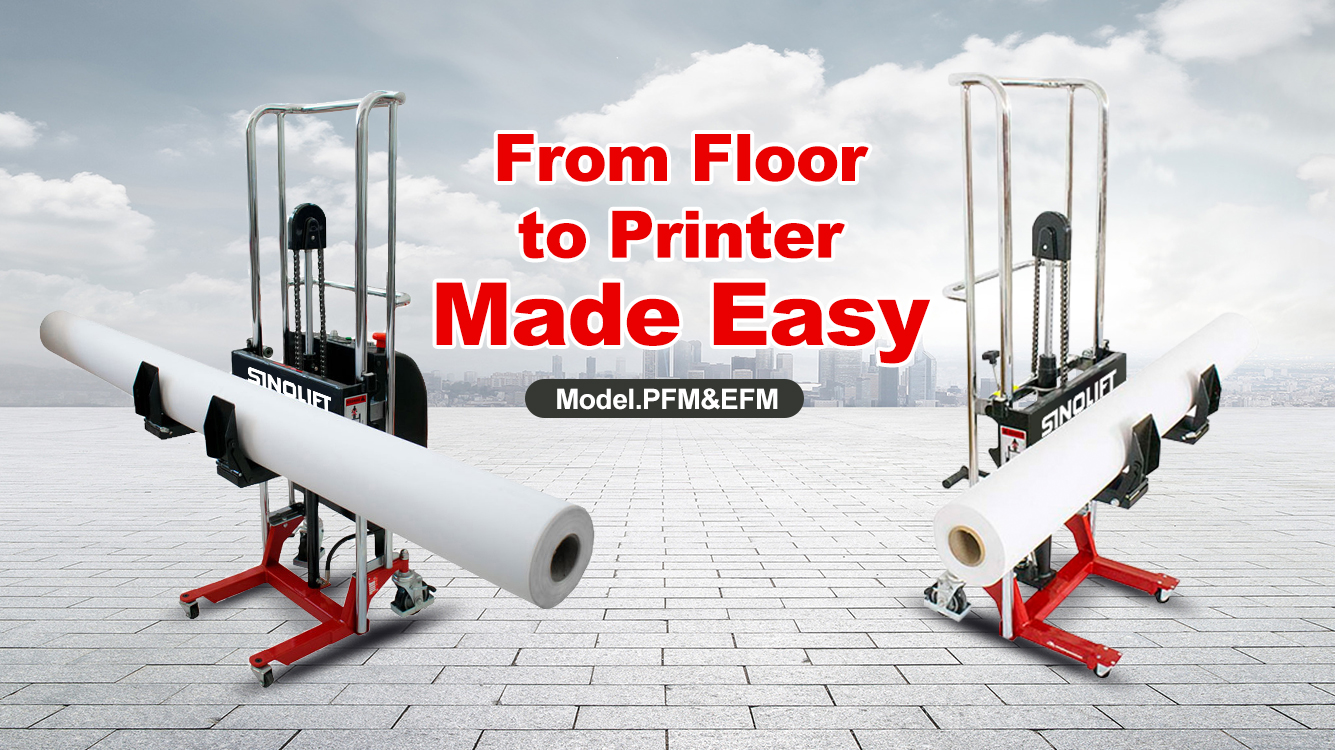
To meet the diverse needs of the printing and textile sectors, SINOLIFT offers two distinct paths for roll management: the PFM and the EFM. Both machines are designed to handle rolls up to 5 meters, but they cater to different operational scales.
The PFM Manual Roll Lifter: Simplicity and Control
The SINOLIFT PFM Manual Roll Lifter is the definitive solution for workshops that value reliability and mechanical simplicity. It is an ergonomic tool that replaces risky manual handling with a stable, labor-saving mechanism.
- Hydraulic Precision: The foot-pump system allows for very fine control. This is particularly useful when you are working with delicate machine spindles that require millimeter-perfect alignment.
- Heavy-Duty Build: Despite its compact size, the PFM is built with high-quality steel and a chrome-plated mast. It is designed to withstand the daily rigors of a busy production floor.
- Aisle-Friendly Design: With its swivel casters and ergonomic auxiliary handle, the PFM can be maneuvered into spaces where a standard forklift would never fit. It is the perfect partner for small-to-medium printing houses.
- Zero-Power Dependency: Because it is fully manual, the PFM is always ready to work. There are no batteries to charge and no electrical components to maintain, making it a "buy-it-and-forget-it" asset for your facility.
The EFM Electric Roll Lifter: Speed and High-Volume Output
For larger facilities where the production pace is fast and the rolls are consistently heavy, the SINOLIFT EFM Electric Roll Lifter provides the necessary power to keep up. It combines electric efficiency with ergonomic safety to maximize productivity.
- Motorized Lifting: The EFM removes the physical effort of pumping a pedal. With simple button controls, the operator can raise a 300 kg roll to the desired height in seconds.
- Intelligent Platform: The smart control panel gives the operator real-time feedback, including battery levels. This prevents downtime and ensures the machine is always operating within its safety parameters.
- Premium Power Source: Equipped with a Tianneng lead-acid battery, the EFM is built for long shifts. The integrated hydraulic pump is optimized for fast, smooth lifting, which is essential for high-throughput packaging and film production lines.
- Enhanced Stability: The EFM features a reinforced chassis and specialized PU wheels that provide a smooth ride for sensitive media. The tilting stop device ensures that even under electric power, the roll remains perfectly secure.
Matching the Equipment to Your Workload
Choosing between these two options depends on your specific "bottlenecks." If your primary concern is safely moving a few heavy rolls a day without injury, the PFM is a logical and cost-effective choice. It provides the stability and safety of a professional lifter with the simplicity of a manual tool.
On the other hand, if your goal is to increase the number of "rolls per hour" that your machines can process, the EFM is the better investment. The reduction in operator fatigue and the increase in lifting speed can significantly improve your bottom line over time.
By integrating a dedicated media roll lifter into your workshop, you aren't just buying a tool; you are upgrading your entire safety culture and operational efficiency. Whether you choose the manual precision of the PFM or the electric power of the EFM, the result is the same: a more organized, safer, and more productive workspace.
For professional product selection guidance or technical support, our expert team is at your service:
Contact Information:
✉ Email: shanghai@sinoliftcorp.com
☎ Phone/WhatsApp: +86 13918731490
We provide:
• Customized equipment recommendations
• Detailed product specifications
• On-site technical consultation
• After-sales support
Get your tailored material handling solution today!
The 5 Must-See Parameters for Choosing a Reel Hydraulic Stacker: A Deep Dive from Load Capacity to "No-Mark" Design
Why Switching to a Lithium Battery Forklift is the Smartest Financial Move for Your Warehouse